Every hotel tech vendor will tell you this is the future. The brochure shows a happy guest breezing past the front desk. But brochures are not budgets. Before you spend on a kiosk or an app, the real question is whether guests will use it and whether it pays for itself.
The short answer is yes, for most hotels, self check-in is worth installing. But not every property, and not without doing it right. The value depends on your guest mix, your volume, and how well you set it up.
Here is the honest case, the numbers, and the catch.
Is Self Check-In Actually Worth It?

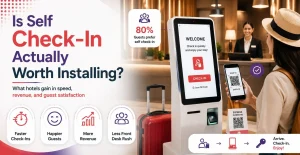
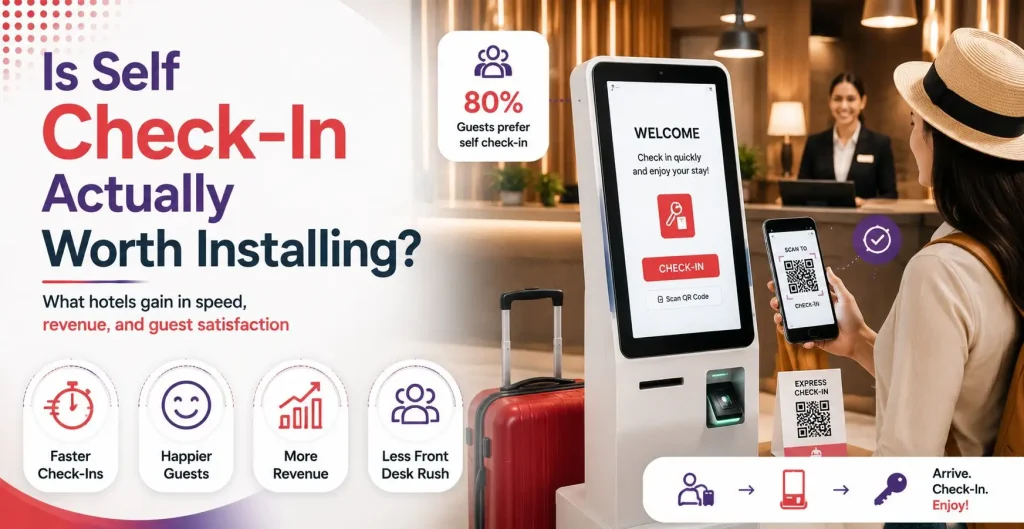
For most modern hotels, yes. Guest demand alone makes the case. Around 70 percent of travelers say they would rather check in through an app or kiosk than wait at a front desk, and that figure jumps to 82 percent among Gen Z.
This is no longer a novelty. Guests now compare your arrival experience to Uber, Airbnb, and Amazon, not just to the hotel down the road. When fast, self-directed arrival is the norm everywhere else, a slow front desk line starts to feel dated. For many travelers, the option to skip it is becoming a basic expectation.
The Real Benefits of Self Check-In
The value is not only about convenience. The returns show up in both the guest experience and the bottom line.
- Faster arrivals: Returning guests can check in within two minutes, with no queue
- Less lobby congestion: Mobile check-in can cut lobby crowding by around a quarter
- More upsell revenue: Kiosk check-in users are far more likely to buy upgrades and add-ons
- 24/7 arrivals: Late or odd-hour guests check in without a staffed desk
- Freed-up staff: Your team spends less time on paperwork and more on real guest care
That upsell point is the one many hoteliers miss. A well-designed check-in kiosk quietly offers a room upgrade or early check-in at the perfect moment, and a meaningful share of guests say yes.
The Downsides Worth Knowing

It is not a magic fix, and pretending otherwise leads to a wasted budget. There are real trade-offs.
There is an upfront cost for the kiosk, software, or app, plus setup and training. Not every guest wants it either. Older travelers, some international guests, and business travelers often still prefer a human face. Technology can also fail, and a frozen screen at arrival is worse than a short line. ID verification and payment security add compliance work too, since you are handling sensitive data without a clerk watching.
None of these kill the idea. They just mean it works best as an option, not a forced replacement.
When Self Check-In Is Worth Installing
The math tips clearly in favor of installing it when a few things are true.
- You handle high arrival volume or frequent peak-hour rushes
- You get late-night or early arrivals that strain a staffed desk
- Your guests skew younger, tech-comfortable, or business-focused
- You run lean on staff and want to protect front desk efficiency
- You want a new upsell channel at the moment of arrival
If most of these fit, it usually pays for itself within months. If you run a small, high-touch boutique where guests come for personal service, the case is weaker.
Also Read: Do Guests Actually Use Hotel Chatbots?
How to Make It Actually Worth It
Installing the hardware is the easy part. Adoption is what decides the return, and a few choices make or break it.
Keep it optional, never forced, so guests who want a person still get one. Use a web-based link instead of demanding an app download, since requiring a download kills adoption fast. Build a smooth handoff to staff for anything tricky, and offer the flow in multiple languages for international guests. A contactless check-in that is quick, clear, and friendly gets used. One that is clunky gets ignored.
Bringing It Together
So, is self check-in actually worth installing? For most hotels, yes. The demand is real, the upsell revenue is real, and the time savings are real. But it is worth it only when you match it to your guests, keep it optional, and make it genuinely easy. Treat it as a smart convenience layer, not a way to remove people, and it earns its place at the door.
FAQs
Is self check-in worth it for small hotels? It can be, especially if you get late arrivals or run on a small team. Even a simple web-based check-in helps cover odd hours without staffing the desk. Very small, high-touch boutiques may get less value, since their guests often come for personal service.
Does self check-in actually increase revenue? Yes, often through upsells. Guests using a kiosk or app are notably more likely to buy room upgrades and add-ons at arrival, which lifts revenue per check-in. It also saves staff time that can go toward guest care.
Do guests still want a front desk? Some do. Older travelers, certain international guests, and those wanting a personal welcome still value a human. That is why it works best as an option alongside the front desk, not a full replacement.
What is the best way to offer self check-in? Use a web-based link guests can open without downloading an app, keep it optional, and build an easy path to a real person. Offering it in multiple languages and keeping the flow under two minutes drives the most use.