
How Can a Small Hotel Run Smoothly With Fewer Staff Than It Needs?
By Foodle+ Team • • 13 MINS READ

Quick Answer: You can run a hotel with fewer staff by deciding what must happen on every shift, pausing what can wait, and moving work out of people's heads and onto a list. Write down who can cover which job, hand over pending requests in writing, and let a system route tasks so nothing depends on one person remembering.
A housekeeper calls in sick, the front desk is already one person short, and checkout is in two hours. If that sounds like your week, you are not alone. In August 2025, the FHRAI president said that hospitality hiring had grown 25% in the first half of the year, and that this points to higher levels of attrition. That is his reading of hiring data, not a measured rate, but it matches what most hotel managers see.
Here is a detail that may change how you plan. A 2025 India survey by Statista and Booking.com, reported in February 2026, found that only 11% of businesses hiring housekeepers expected difficulty. For managers, seven businesses reported difficulty for every one that found it easy. So the hard part is often not finding a pair of hands. It is keeping the experienced people who know how your hotel really runs.
This guide shows why small hotels end up short, how to decide what to do first, how to plan the day and cover a shift, and how to keep service steady between shifts. It ends with a 14-day plan and answers to the questions managers ask most. You can start most of it tomorrow with no new tools.
- Why Do Small Hotels End Up Short of Staff?
- What Work Can Wait, and What Cannot?
- How Should You Plan the Day When You Are Short?
- How Do You Cover a Shift When Someone Does Not Turn Up?
- How Do You Keep Service Steady Between Shifts?
- What Should You Stop Doing by Hand?
- How Do You Train New Staff Fast Enough?
- What Should You Track to Know It Is Working?
- What Should Your First 14 Days Look Like?
- Frequently Asked Questions
- So, Where Should You Start?
Why Do Small Hotels End Up Short of Staff?
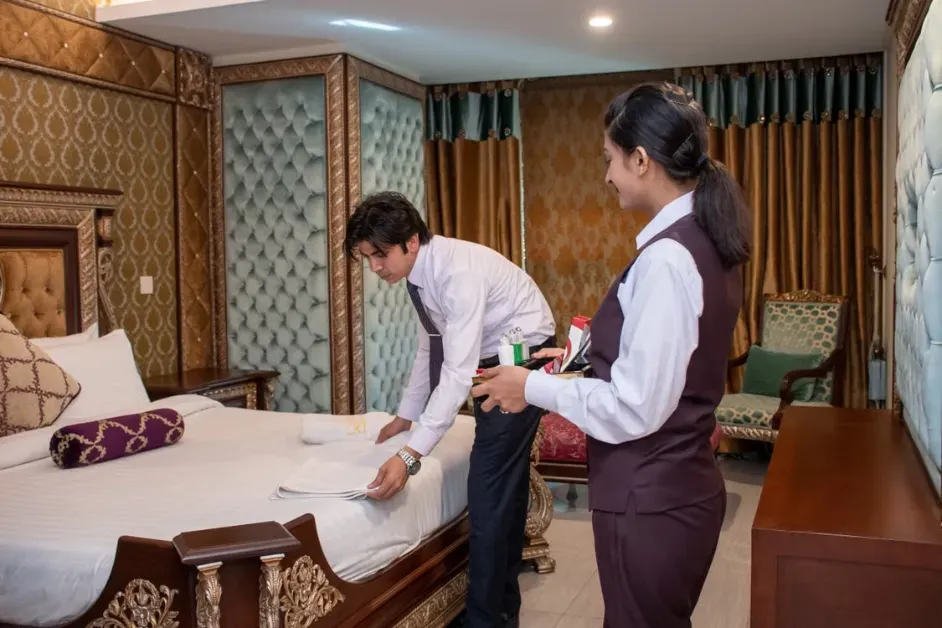
Small hotels end up short because the know-how sits in a few heads, and when one person leaves, that knowledge leaves too. New people are easier to find than good supervisors. So the gap is usually felt in the middle: the person who knew which rooms stick, which guest wants what, and what the owner expects.
Five things make it worse.
- One person does three jobs. The front desk handles check-in, billing and room service orders, and a single absence breaks all three.
- Work comes in waves. Checkout, check-in and dinner all land in the same two or three hours, so a short team feels it most then.
- Requests travel by phone call, radio and word of mouth. If the person who took the message is busy, the request waits.
- Training is "follow Ramesh for a week". When Ramesh is the one who quit, the new person has nobody to follow.
- Seasons swing fast. A festival weekend can double the load, and you cannot hire for two days.
What Work Can Wait, and What Cannot?
Sort your work into three piles: must happen every shift, can wait a day or two, and can stop for now. When you are short, guests should feel almost no change in the first pile. The third pile is where you find your breathing room.
Do this sorting with your department heads for ten minutes, not alone. They know which tasks guests never notice. Write the result on one page and keep it where the team can see it.
Be honest about guest-facing items too. If you cannot serve a full menu with a short kitchen, a smaller menu done well beats a long menu done slowly.
How Should You Plan the Day When You Are Short?
Plan the day in three blocks, morning, afternoon and evening, and give each block three to five priorities. A short team cannot do everything at once, so the plan tells people what to do first and what to leave. Adjust the blocks to fit your hotel.
- Morning: departures, rooms ready for the earliest arrivals, breakfast service and correct checkout bills.
- Afternoon: arrivals, guest requests, quick fixes for small problems and restaurant preparation.
- Evening: dinner service, security rounds, shift handover and a list for tomorrow.
Put the three blocks on a single page next to your three piles. When a new problem lands, the team can check the page instead of asking you.
How Do You Cover a Shift When Someone Does Not Turn Up?
Cover a shift by knowing in advance who can do which job, so you are not working it out at 6 AM. Keep a one-page cover sheet that lists each role, the main person and one or two backups. Then, on the day, move the must-do work first and push the rest.
- Keep a cover sheet for every role. For each role, write the main person and two people who can step in. Update it when someone joins or leaves.
- Cross-train in pairs. Teach each person one job outside their own, such as a housekeeper learning to mark room status or a front desk executive learning the basics of the kitchen order flow.
- Hold a five-minute huddle at the start of each shift. Say who is in, who is out, which rooms and tables matter most, and who covers what.
- Move work, not just people. If housekeeping is short, clean arrival rooms first and leave stayover rooms for later in the day. Guests who can schedule room cleaning from a hotel app also make your room plan easier to run.
- Keep a short on-call list. People who have worked with you before, ex-staff and trusted local contacts are easier to bring in for a busy day than fresh hires.
- Say thank you in a way that counts. If staff cover for each other, give a small token, a meal or time off later. It is cheaper than losing them.
How Do You Keep Service Steady Between Shifts?

Keep service steady by writing down what is pending when a shift ends, so the next person starts with the full picture. Most missed requests are not lost by careless staff. They slip through the gap between two people, when something was said but never written.
A good handover note is short. It has four lines:
- Rooms: which are ready, which are not, and which have a repair open.
- Guests: any request still pending, any complaint, any special arrival.
- Money: bills open, advances taken, charges that still need posting.
- Next shift: anything the owner or manager asked to be done.
Keep it on a shared sheet or in the system, not on a loose page. The person leaving signs it. The person arriving reads it out to the team in the huddle.
This matters more when you are short, because everyone is moving fast and memory is the first thing to slip.
What Should You Stop Doing by Hand?
Stop doing by hand the jobs that eat the most minutes and add the least value. These are usually relaying messages, copying the same information twice and adding up bills. Pick one, fix it, and then pick the next.
- Relaying requests by phone. Every call to housekeeping takes a minute from two people. A request that goes straight to the right person on their phone takes no calls at all.
- Chasing room status. If the desk has to ask whether a room is ready, someone is walking the floor to find out. A live status shows it at a glance.
- Writing the same details twice. Guest details typed once at the desk and again in a register double the work and double the mistakes.
- Totalling bills by hand. Restaurant, spa and room charges added at the end of a stay are where errors and missed charges slip in.
Software does not replace people here. It takes over the passing of messages, so your team spends its time on guests. To see how this works day to day, read how hotel automation improves day-to-day operations and explore the hospitality automation features.
How Do You Train New Staff Fast Enough?
Train new staff on one task at a time, with a written checklist and a buddy who is on the same shift. A new joiner who learns the five most common jobs well in the first week is more useful than one who has seen everything and can do nothing.
- Start with the must-do pile. Check-in, a room clean to your standard, taking and delivering an order.
- Use a one-page checklist per job. It should show the steps in order, with photos where they help.
- Pair them with someone on the same shift, not someone on the opposite one.
- Check in on day three and day seven. Ask what is confusing and fix the checklist, not the person.
- Keep the checklists up to date. When a good person leaves, the checklist stays.
Training pays off even if staff leave. In the same India survey, 41% of respondents said they planned to invest more in developing their staff. A written checklist is the cheapest form of that investment, because it stays with you when people go.
What Should You Track to Know It Is Working?
Track four numbers each week. They are requests that went late or missed, average time to finish a request, overtime hours, and how many staff left in the quarter. Look at them on the same day each week and compare with the week before.
- Late or missed requests. Count the requests that took longer than your own standard, or that a guest had to repeat. A falling count means handover and routing are working.
- Time to finish a request. The average minutes from request to done. A system shows this on its own. Without one, note the time on a sheet for a week.
- Overtime hours. If overtime is climbing, your team is covering gaps at a cost you may not see until someone quits.
- Staff who left in the quarter. This is the number behind all the others. Ask each person who leaves what would have kept them.
Do not set a target at first. Collect two or three weeks of numbers, then fix the one that hurts most.
What Should Your First 14 Days Look Like?
Spend the first three days sorting, the next four setting routines, and the last week taking one job off your team's hands. This order works because each step makes the next one easier. Do not start with tools. Start with the work.
- Days 1 to 3: sort tasks into the three piles with your department heads, and write the cover sheet for every role.
- Days 4 to 7: start the five-minute huddle and the four-line handover note, and write one-page checklists for your three most important jobs.
- Days 8 to 10: pick the one manual job that eats the most minutes, such as relaying requests or chasing room status, and fix it first.
- Days 11 to 14: start tracking the four numbers, and ask your team what still slows them down.
- After day 14: review the numbers, keep what helped, and choose the next job to take off the team.
FAQs
How many staff does a small hotel need?
How can a hotel manage with less housekeeping staff?
Should a short-staffed hotel cut services?
Can software replace hotel staff?
How do you train new hotel staff quickly?
How do you keep a short-staffed team from burning out?
So, Where Should You Start?
You do not need to solve hiring to run a steadier hotel. This week, sort your tasks into three piles, write a cover sheet for every role, and start a four-line handover note. Then pick one job you do by hand and take it off your team's plate. In two weeks, look at the four numbers and decide what to fix next.
Related Posts

Hospitality
What Should a Hotel Shift Handover Include So Nothing Gets Missed?
22 Oct 2026

Hospitality
How Hotels Reduce OTA Dependency and Pay Less Commission
21 Oct 2026

Hospitality
Wedding Season Checklist Hotels Need: How to Prepare Your Hotel
21 Oct 2026