
How Can a Hotel Avoid Billing Errors at Checkout?
By Foodle+ Team • • 10 MINS READ

Hotel billing errors at checkout rarely come from big mistakes. They come from small gaps: a restaurant bill that reaches the desk late, a charge posted to the wrong room, or a rate typed in twice. This guide shows the common causes and the simple checks that stop each one.
Most of these fixes cost nothing and your front desk can start them this week. If bills are getting heavy to manage by hand, there is also a section on when software helps.
- Why Do Billing Errors Happen at Checkout?
- Which Billing Errors Are Most Common, and How Do You Stop Each One?
- What Should Your Front Desk Do Before Checkout?
- How Do You Post Charges to a Guest's Room Correctly?
- How Should You Handle Discounts, Voids and Corrections?
- How Do You Get GST Right on the Bill?
- What Should You Do When a Guest Disputes the Bill?
- How Can Software Help With Billing Errors?
- What Should You Track to Know It Is Working?
- Frequently Asked Questions
- So, Where Should You Start?
Why Do Billing Errors Happen at Checkout?
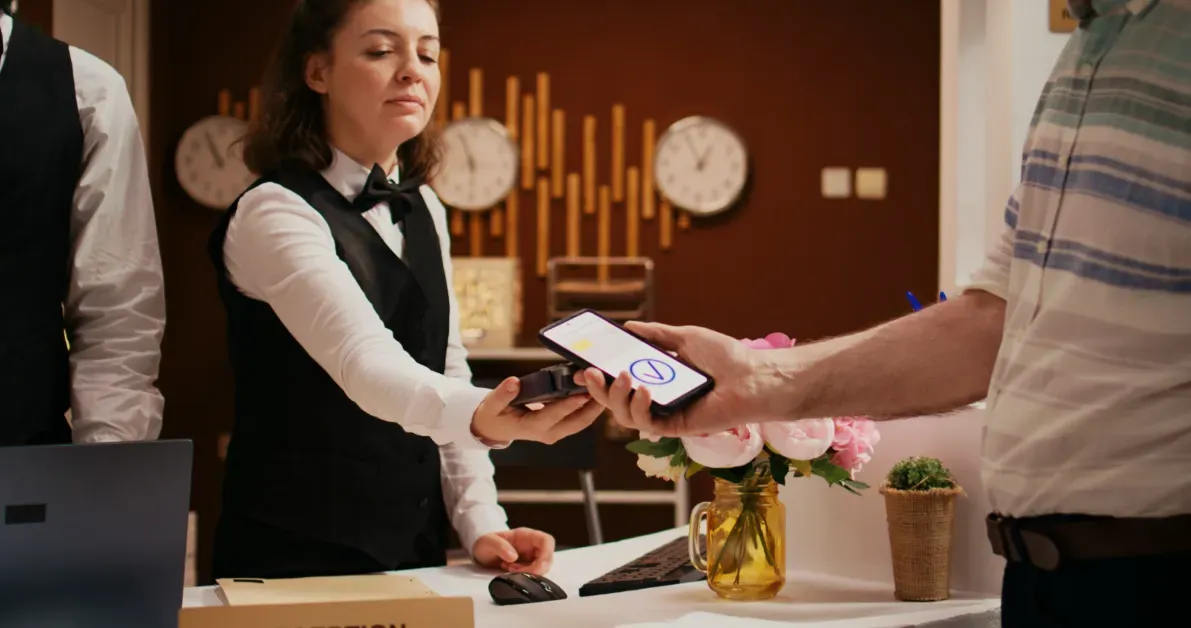
Billing errors happen because charges come from many places, and each place records them in a different way and at a different time. The restaurant, spa, minibar, laundry and front desk all add to one guest bill. If even one of them is late or unclear, the final bill is wrong.
Guests notice. In an informal 2021 poll of a travel group, reported by The Points Guy, 91.5% of respondents said they had faced a bill error at checkout. It was not a scientific survey, but it shows that guests do run into this often.
These are the usual causes.
- Late posting. A restaurant or spa bill reaches the desk after the guest has already left.
- Notes on paper. A charge written on a slip or chit gets lost before anyone enters it.
- Double entry. The same charge is written in a register and typed into the system, so it appears twice.
- Wrong room. A charge goes to the wrong room because the number was said aloud in a busy restaurant.
- Wrong rate or tax. A rate change or a tax setting was not updated in time.
- Unrecorded changes. A discount, free item or waiver was agreed but never noted.
- Stay changes. An early departure or an extra night is not updated on the bill.
An error costs you either way. A missed charge is revenue you never bill, and an extra charge leads to an argument, a refund and sometimes a bad review.
Which Billing Errors Are Most Common, and How Do You Stop Each One?
Each common error has a simple cause and a simple fix. Use this table as a checklist with your front desk and department heads.
| Error | Why it happens | How to stop it |
|---|---|---|
| Missed or late charge | Outlet bill reaches the desk after checkout | Ask outlets to post or send bills right after service, and review open charges the night before |
| Duplicate charge | Same item entered in two places | Pick one place to enter charges and stop the second register |
| Charge on the wrong room | Room number said aloud or misheard | Ask for the room key or ID, read the number back and confirm the guest name |
| Wrong rate | Rate or plan changed but not updated | Check the rate against the booking at check-in and again before checkout |
| Wrong tax | Tax set by hand or left unchanged | Set tax in the system and review it whenever the rules change |
| Unrecorded discount or free item | Agreed on the floor, not noted | Record every discount with a reason and the name of who approved it |
| Wrong number of nights | Early departure or extension not updated | Check departure dates on the morning list |
What Should Your Front Desk Do Before Checkout?
Check the bill before the guest comes to the desk, not while they stand waiting. A bill that has been checked the evening before takes a minute to hand over. A bill checked at the counter takes ten and starts an argument.
- Post charges as they happen. Do not wait for the end of the stay. Every outlet should send each bill to the desk during the same shift.
- Check open charges every evening. Look at rooms due to leave tomorrow and ask each outlet if anything is still pending.
- Read the bill line by line. Check the rate, the number of nights, the tax and every extra charge against the booking.
- Share the bill early. Offer the guest a copy the evening before, so they can raise questions while there is time to fix them.
- Run the night audit with care. Look at anything unusual, such as a very high charge, a missing charge or a manual edit.
- Look at the morning departure list. Confirm each room, the departure date and any late checkout.
- Hand over the bill and walk through it. Read the main lines with the guest, then ask if anything looks unclear.
How Do You Post Charges to a Guest's Room Correctly?
Post a charge to a room only after you confirm the room and the guest. This single habit removes most wrong-room errors. It matters most in restaurants, bars and poolside outlets, where the room number is often said aloud.
- Ask for the room key or ID before you post.
- Read the room number and guest name back to the guest.
- Ask the guest to sign the slip when it is a room charge.
- Post the charge in the same shift, not the next morning.
- Give each room one bill per outlet, with the items listed.
- Never post a charge from a number you heard across a counter.
How Should You Handle Discounts, Voids and Corrections?
Every change to a bill needs a reason and a name. When a staff member removes a charge or gives a discount, the system or the register should show what was changed, why and who approved it. Without this, small leaks stay hidden.
- Keep the original entry. Do not overwrite it.
- Write a short reason, such as "late room service" or "guest complaint".
- Ask a manager to approve discounts above a limit you set.
- Use a void when a charge should never have been there, and an adjustment when the charge was real but the amount was wrong.
- Review all changes once a week. A pattern, such as the same staff member or the same outlet, shows where to look.
How Do You Get GST Right on the Bill?
Set the GST in your system and review it each time the rules change, instead of working it out by hand. The tax on a hotel bill depends on the room tariff and the type of service, and the rules have changed more than once. A fixed number remembered by staff is how wrong tax reaches the bill.
- Keep the tax setting in one place so every bill uses the same rule.
- Show room charges and food charges as separate lines.
- Take the guest's GST details at check-in when the bill is for a company.
- Check the current notifications on the GST portal or ask your chartered accountant when a rule changes.
- Review a sample of bills each month to confirm the tax is correct.
What Should You Do When a Guest Disputes the Bill?
Stay calm, show the itemised bill and fix real mistakes at once. Most guests accept a clear explanation. What they do not accept is a defensive answer or a bill they cannot read.
- Listen to the full complaint before you reply.
- Show the itemised bill and find the line the guest is asking about.
- Check the source, such as the outlet slip, the signed room charge or the booking.
- If the charge is wrong, remove it right away and say sorry.
- If the charge is right, explain it in plain words and show the proof.
- Write down what happened and how you fixed it. This shows you which step to improve.
How Can Software Help With Billing Errors?
Software helps with hotel billing errors at checkout by taking over the passing of charges, so no one has to copy them by hand. It works best after you have the routine above, because it speeds up a good habit and does not replace one.
Foodleplus PMS (Property Management System) includes billing and invoicing with automatic GST on the invoice. Foodleplus Hotel POS (Point of Sale) posts restaurant, spa and service charges to the guest folio through its PMS integration, and the GST on those charges reaches the front office with them. The desk sees one bill per guest, with each outlet's charges listed. Reports show net revenue, room revenue and tax for any date range, which helps you check the numbers at night audit.
What Should You Track to Know It Is Working?
Track four numbers each week and compare them with the week before.
- Bills corrected after checkout.
- Charges found late at night audit.
- Guest disputes per 100 checkouts.
- Minutes the guest waits at the desk at checkout.
Do not set a target on day one. Collect two or three weeks of numbers, then fix the one that hurts most.
FAQs
How can a hotel avoid billing errors at checkout?
What are the most common hotel billing mistakes?
What should a hotel do if a billing error is found after the guest leaves?
How do you stop missed charges from the restaurant and minibar?
Do small hotels need software to avoid billing errors?
How often should a hotel check bills for errors?
So, Where Should You Start?
You do not need new tools to cut hotel billing errors at checkout. This week, ask every outlet to send bills in the same shift, check tomorrow's departures each evening, and record every discount with a reason. After two weeks, look at your four numbers and choose the next fix.
Related Posts
Property Management System
Do Small Hotels Need a PMS or Is a Hotel Register Enough?
14 Oct 2026
Hospitality
Why Hotels Lose Money Through Manual Operations (And How Hotel Operations Automation Solves It)
19 Aug 2026
Property Management System
Cloud PMS vs Traditional PMS: Which Is Better for Modern Hotels?
19 Aug 2026