
Cloud PMS vs Traditional PMS: Which Is Better for Modern Hotels?
By Foodle+ Team • • 9 MINS READ
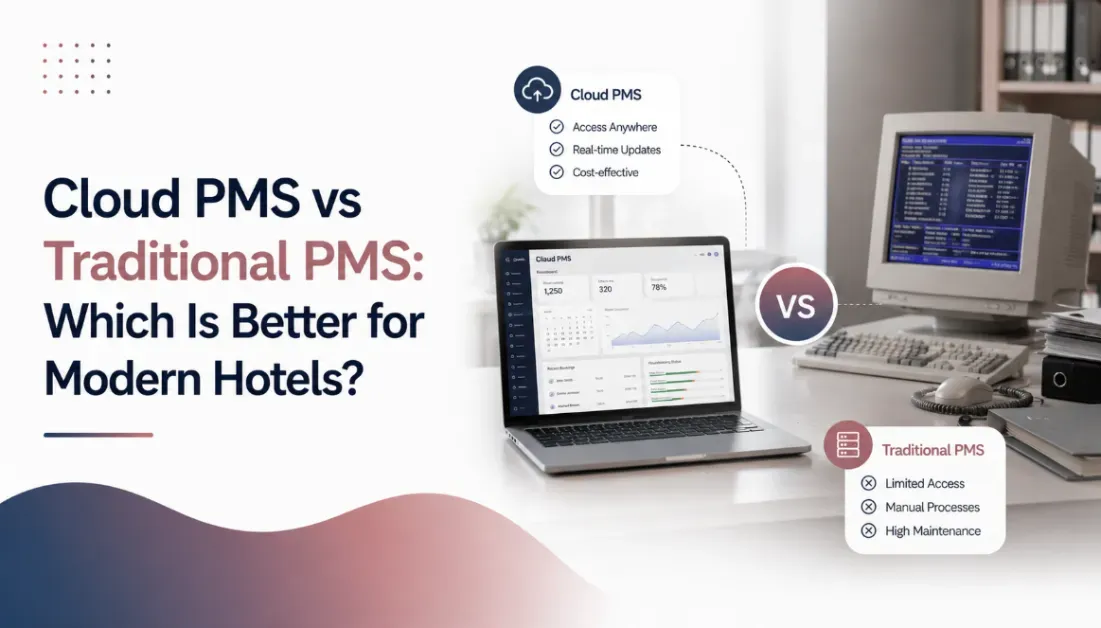
If you're comparing Cloud PMS vs Traditional PMS, the answer is straightforward for most hotels today Cloud PMS offers greater flexibility, lower IT costs, easier integrations, and remote access, making it the preferred choice for modern hospitality businesses.
However, that doesn't mean traditional Property Management Systems are obsolete. Some large hotels with legacy infrastructure still rely on on-premise systems due to specific operational or compliance requirements.
The right choice depends on your hotel's size, budget, technology strategy, and future growth plans. Here's a detailed comparison to help you decide.
- Cloud PMS vs Traditional PMS: At a Glance
- What Is a Cloud PMS?
- What Is a Traditional PMS?
- Cloud PMS vs Traditional PMS: Detailed Comparison
- Why More Hotels Are Choosing Cloud PMS
- Which Hotels Should Choose a Traditional PMS?
- Which Hotels Benefit Most from Cloud PMS?
- The Future of Hotel Property Management
- Final Thoughts
- Frequently Asked Questions
Cloud PMS vs Traditional PMS: At a Glance
What Is a Cloud PMS?

A cloud hotel PMS is hosted on secure cloud servers and accessed through a web browser or mobile application.
Instead of installing software on hotel computers, the vendor manages the infrastructure, software updates, security patches, and backups.
This allows hotel teams to manage reservations, housekeeping, guest profiles, reports, and operations from virtually anywhere.
What Is a Traditional PMS?
A traditional hotel property management system is installed on local servers inside the hotel.
The hotel owns and maintains the hardware, software licenses, security, backups, and updates.
While these systems were the industry standard for years, they require higher upfront investment and dedicated IT support.
Cloud PMS vs Traditional PMS: Detailed Comparison
1. Cost
Cost is one of the biggest differences between both systems.
A traditional PMS usually requires:
- Server infrastructure
- Software licenses
- Database setup
- Installation fees
- Annual maintenance
- IT staff
Cloud PMS solutions generally work on a subscription model, eliminating the need for expensive hardware purchases.
For growing hotels, this significantly reduces capital expenditure (CapEx) and converts it into predictable operational expenses (OpEx).
Winner: Cloud PMS
2. Accessibility
Modern hotel operations don't stop at the front desk.
Hotel managers often need to monitor occupancy, revenue, housekeeping, and guest requests while traveling or managing multiple properties.
Cloud PMS provides secure access from:
- Laptop
- Tablet
- Smartphone
Traditional PMS generally restricts access to devices connected to the hotel's local network.
Winner: Cloud PMS
3. Software Updates
Hotel technology evolves rapidly.
Cloud PMS vendors continuously release:
- New features
- Security improvements
- OTA integrations
- Performance updates
These updates happen automatically without disrupting hotel operations.
Traditional PMS often requires scheduled maintenance and manual upgrades, which can involve downtime.
Winner: Cloud PMS
4. Security & Data Protection
One common misconception is that cloud systems are less secure.
In reality, leading cloud PMS providers use:
- End-to-end encryption
- Multi-factor authentication
- Automated backups
- Disaster recovery systems
- Continuous security monitoring
Hotels using traditional PMS are responsible for maintaining server security, backup schedules, and hardware reliability.
A server failure without proper backups can result in significant operational disruption.
Winner: Cloud PMS
5. Integrations
Today's hotels use multiple software platforms.
A modern PMS should integrate with:
- Channel Managers
- Booking Engines
- Revenue Management Systems
- Point of Sale (POS)
- Payment Gateways
- CRM Platforms
- Guest Messaging Tools
- Housekeeping Software
Cloud PMS platforms are built with APIs that enable seamless integrations.
Traditional systems often require custom development or middleware to connect with third-party software.
Winner: Cloud PMS
6. Scalability
If you plan to expand from one property to multiple hotels, scalability becomes critical.
Cloud PMS allows hotels to:
- Add new properties
- Increase room inventory
- Create additional user accounts
- Centralize reporting
without investing in additional servers.
Traditional PMS often requires new infrastructure as the business grows.
Winner: Cloud PMS
7. Business Continuity
Unexpected events like hardware failures, power outages, or natural disasters can interrupt hotel operations.
Cloud PMS solutions typically include redundant cloud infrastructure and automatic backups, allowing hotels to recover data quickly.
With on-premise systems, recovery depends entirely on the hotel's backup strategy and hardware setup.
Winner: Cloud PMS
Why More Hotels Are Choosing Cloud PMS

The hospitality industry is rapidly moving toward cloud-based technology.
According to Hotel Tech Report's Hotel Tech Index, cloud-native Property Management Systems have become the preferred choice for independent hotels and hotel groups because they simplify operations, reduce IT maintenance, and integrate easily with other hotel technologies.
The shift is also reflected in market research. Multiple industry reports project the global Hotel Property Management System market to grow significantly over the next decade, driven by increasing digital transformation, mobile operations, contactless guest experiences, and multi-property management.
Simply put, hotels are investing in technology that scales with their business instead of maintaining expensive on-site infrastructure.
Which Hotels Should Choose a Traditional PMS?
Although cloud adoption is accelerating, traditional PMS can still be suitable for:
- Hotels with strict on-premise compliance requirements
- Properties with existing legacy infrastructure
- Organizations with dedicated IT departments
- Hotels that prefer complete control over their servers
However, these situations are becoming less common as cloud technology matures.
Which Hotels Benefit Most from Cloud PMS?
Cloud PMS is ideal for:
- Boutique Hotels
- Resorts
- Hotel Chains
- Business Hotels
- Homestays
- Serviced Apartments
- Vacation Rentals
It is especially valuable for hotel groups managing multiple properties from a centralized platform.
The Future of Hotel Property Management
The hospitality industry is becoming increasingly connected.
Hotels now expect their PMS to work seamlessly with:
- Online Travel Agencies (OTAs)
- Revenue Management Systems
- Guest Messaging Platforms
- Digital Check-in Solutions
- Housekeeping Apps
- Business Intelligence Dashboards
- AI-powered guest service tools
Cloud-native architecture makes these integrations faster and easier to implement than traditional on-premise systems.
As guest expectations continue to evolve, hotels adopting flexible, connected technology will be better positioned to improve operational efficiency and deliver personalized guest experiences.
Final Thoughts
When comparing Cloud PMS vs Traditional PMS, cloud-based systems offer clear advantages in flexibility, scalability, accessibility, and integration capabilities.
While traditional PMS may still serve specific operational needs, most hotels today benefit more from cloud technology due to its lower infrastructure costs, automatic updates, stronger interoperability, and support for modern hospitality workflows.
For hotels planning long-term growth, investing in a cloud-based Property Management System is not just a technology upgrade—it's a strategic decision that supports operational efficiency, better guest experiences, and future-ready hotel management.
FAQs
Is Cloud PMS better than Traditional PMS?
Is Cloud PMS secure?
Can a Cloud PMS work for multiple hotel properties?
Why are hotels moving to Cloud PMS?
What should hotels consider before choosing a PMS?
Related Posts
Hospitality
Why Hotels Lose Money Through Manual Operations (And How Hotel Operations Automation Solves It)
19 Aug 2026
Property Management System
PMS vs Channel Manager: What's the Difference and Do Hotels Need Both?
25 Aug 2026
Property Management System
Best Hotel PMS Software: How to Choose the Right System for Your Hotel
8 Sept 2026