
How Do You Track Profit for Each Outlet in Your Hotel?
By Foodle+ Team • • 10 MINS READ
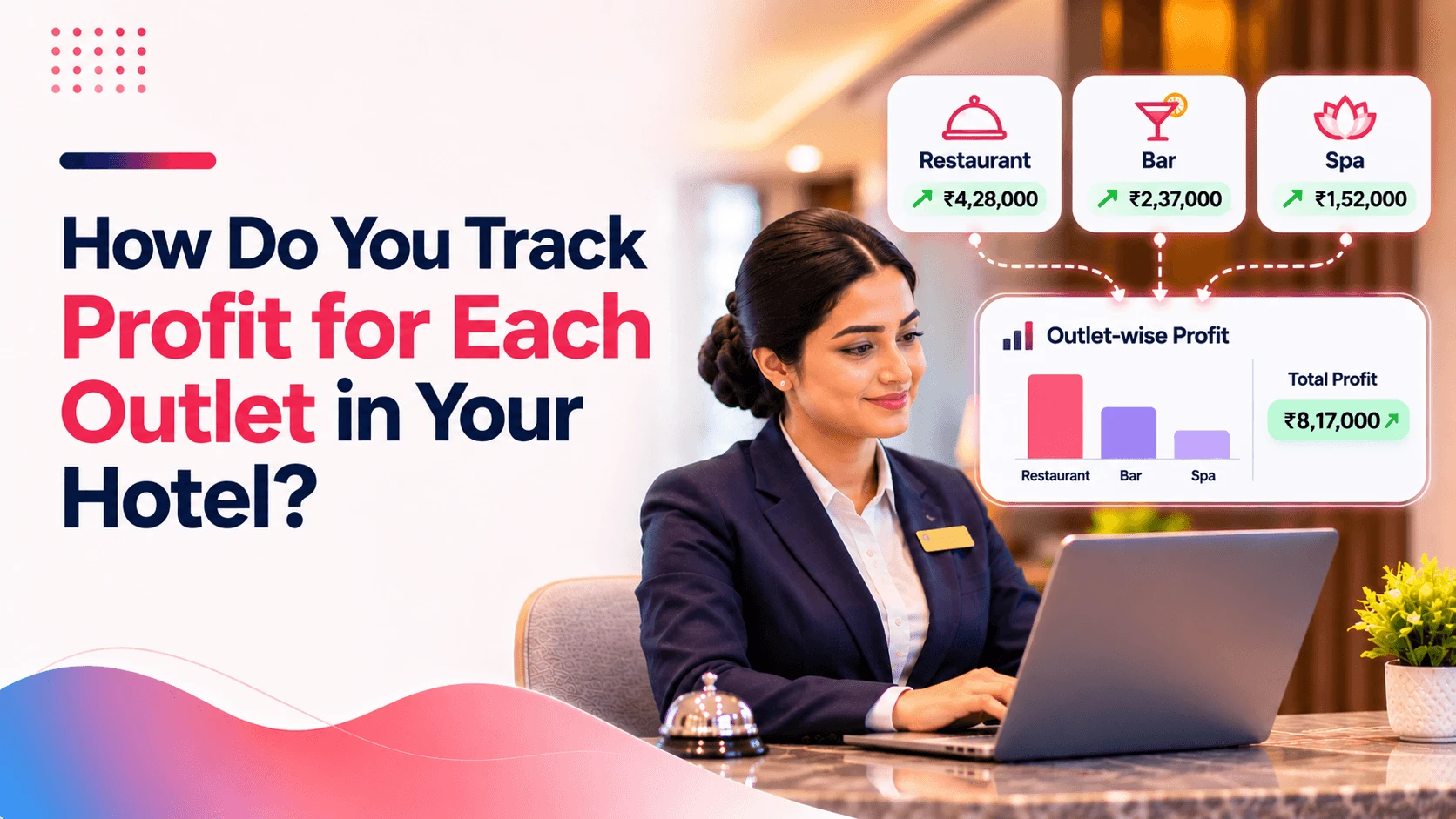
Quick Answer: To track hotel outlet profitability, treat each outlet like its own small shop. Record its sales, the food and drink it used, the staff who worked there, and a fair share of shared costs like the kitchen. Then subtract. Sales minus all those costs is that outlet's profit. Do it every month, and check sales every day.
Your restaurant was full on Saturday night. Every table, two rounds. The bar had a crowd too, and you signed off three banquet bookings that week.
Then the month ends, and the profit number is... fine. Just fine.
So where did the money go?
Most owners never find out, because the accounts show one big food and beverage number. The restaurant, the bar, room service and banquets all get mixed together. A busy outlet can hide a weak one for months. Sometimes years.
The fix isn't complicated. You just stop looking at one number and start looking at four.
- How to Track Profit for Each Hotel Outlet in 5 Steps
- A Simple Example: One Month, Four Outlets
- Which Hotel Outlet Usually Makes the Most Money?
- What Should You Track Every Day, Week and Month?
- Why One F&B Number Hides the Truth
- 5 Mistakes That Make Outlet Profit Look Wrong
- What to Do When an Outlet Is Losing Money
- Can Software Track Profit by Outlet for You?
- FAQs
How to Track Profit for Each Hotel Outlet in 5 Steps
You don't need an accountant for this. You need clean records and one simple sum.
| Step | What to do | Why it matters |
|---|---|---|
| 1. Set up each outlet separately | Restaurant, bar, room service, banquet, poolside. Each one gets its own name in your billing | If bills aren't tagged to an outlet, you can't split anything later |
| 2. Record sales per outlet daily | Every bill carries its outlet name, even when it goes to the guest's room bill | A room service order charged to Room 108 is still room service money |
| 3. Count each outlet's direct costs | Food and drink used, staff who work only there, things only that outlet uses | These are the costs that would vanish if the outlet closed |
| 4. Share common costs fairly | Split shared kitchen staff, gas and power by each outlet's share of sales or orders | Otherwise the restaurant carries costs that belong to room service |
| 5. Do the sum | Sales minus direct costs minus shared costs | That's the outlet's profit before hotel-wide costs like your GM's salary |
Step 4 is where most owners go wrong. Say one kitchen cooks for both the restaurant and room service. If the restaurant makes 87 of every 100 rupees of food sales, it takes 87% of the kitchen staff cost. Room service takes the other 13%. Simple, and fair enough for decisions.
And here's the profit percentage, in one line:
Outlet profit % = outlet profit ÷ outlet sales × 100
That percentage is how you compare a busy restaurant with a quiet bar. Big sales don't mean big profit.
A Simple Example: One Month, Four Outlets
These numbers are made up for this guide, but the pattern is one many hotel owners will recognise. Look at the restaurant first, then look at the last column.
| Outlet | Sales | Food and drink cost | Staff cost | Other direct costs | Outlet profit | Profit % |
|---|---|---|---|---|---|---|
| Restaurant | ₹6,00,000 | ₹1,86,000 | ₹1,50,000 | ₹24,000 | ₹2,40,000 | 40.0% |
| Bar | ₹2,50,000 | ₹60,000 | ₹50,000 | ₹10,000 | ₹1,30,000 | 52.0% |
| Room service | ₹90,000 | ₹30,000 | ₹55,000 | ₹8,000 | −₹3,000 | −3.3% |
| Banquet | ₹4,00,000 | ₹1,40,000 | ₹90,000 | ₹60,000 | ₹1,10,000 | 27.5% |
| Total | ₹13,40,000 | ₹4,77,000 | 35.6% |
See what happened?
The restaurant brings in the most money. But the bar keeps more of every rupee. And room service is losing money every month, quietly, because one night staff member costs more than the orders bring in.
None of that shows up in the total. A 35.6% food and beverage profit looks perfectly healthy. That's exactly why you split it. Hotel outlet profitability is really just this table, kept up every month.
Which Hotel Outlet Usually Makes the Most Money?

It depends on your hotel, which is the whole point of tracking it. Still, a few patterns show up often.
Bars often keep a bigger share of each sale, because drinks need less cooking and less kitchen staff than food.
Restaurants bring in steady sales, but food cost and staff cost both run high. A full restaurant can still have thin profit.
Room service is often the weakest. One tray, one order, one person walking it up three floors. Data from STR on US full-service hotels found that hotels doing a lot of in-room dining had lower food and beverage profit: 17.9% against an average of 25.9%. That data is from 2012 and from the US, so treat it as a pattern, not a number for your hotel.
Banquets swing the most. One wedding can make your month, and one badly priced event can wipe out three good ones. Track banquet profit per event, not just per month.
What Should You Track Every Day, Week and Month?

You don't need to do the full sum every day. Here's a simple rhythm.
| How often | What to check | What it tells you |
|---|---|---|
| Every day | Sales per outlet, number of orders or covers, average bill | Which outlet is busy, and which one suddenly went quiet |
| Every day | Free meals, cancelled bills and discounts per outlet | Where money is leaking without anyone noticing |
| Every week | Stock used per outlet against what it sold | Whether food and drink cost is creeping up |
| Every month | Full outlet profit and profit % | Which outlet is earning, and which one needs fixing |
| Every event | Banquet sales against everything that event cost | Whether your banquet prices are right |
Sales per outlet every single day is the habit that matters most. If you only do one thing from this guide, do that.
Why One F&B Number Hides the Truth
A typical hotel profit and loss statement splits money by department: rooms, food and beverage, and other income. That's useful for accountants and lenders. But food and beverage is one line, so your restaurant, bar, room service and banquets all sit inside it together.
As an owner, you make decisions outlet by outlet. Should the bar open at noon? Is room service worth running after 11 pm? Are banquet prices too low? One combined number can't answer any of these.
So keep the standard accounts, and keep an outlet view next to them.
5 Mistakes That Make Outlet Profit Look Wrong
Even owners who try to track this often get numbers that don't make sense. Usually it's one of these.
- Room charges lose their outlet name.: A guest orders dinner to the room, it goes on the room bill, and later nobody knows it was room service. Always tag the outlet before the charge moves.
- Stock goes to "the kitchen", not to an outlet.: If 20 kg of chicken leaves the store with no outlet named, you can't tell which outlet used it.
- Free meals aren't written down.: Staff meals, complimentary drinks and owner's guests all cost money. If they're not recorded, food cost looks higher and nobody knows why.
- The restaurant carries the whole kitchen.: If room service and banquets use the same kitchen, they take their share of its cost. Otherwise the restaurant looks worse than it is.
- Banquet extras are paid separately.: Decoration, a DJ, extra power or hired staff often get paid in cash or by another account. Then the banquet looks more profitable than it really was.
Fix these five, and your outlet numbers start telling the truth.
What to Do When an Outlet Is Losing Money
Don't close it straight away. Guests may expect it, and some outlets help you sell rooms even when they lose a little. Fix it first.
| Outlet | Common reason it loses | What usually helps |
|---|---|---|
| Room service | Staff cost too high for the number of orders | Shorter menu, set hours, a tray charge, and taking orders by room QR instead of phone |
| Restaurant | Food cost too high, or too many dishes nobody orders | Cut slow dishes, check portion sizes, review prices on top sellers |
| Bar | Stock missing between the store and the glass | Count bottles weekly, fix standard pours, check free drinks |
| Banquet | Price per plate too low, or extras not charged | Cost every event before quoting, and charge decor and extras clearly |
Then give it two or three months and check the number again. If an outlet still loses money after real fixes, that's the time to make a harder call.
Can Software Track Profit by Outlet for You?
It can do most of the hard part. A paper register or one big spreadsheet usually can't keep outlets apart, especially when charges move to the guest's room bill.
If you're choosing an F&B management system for hotels to help with hotel outlet profitability, look for these things:
- Separate billing for each outlet: restaurant, bar, room service, banquet and more
- Outlet charges that reach the guest's room bill without losing their outlet name
- Stock records you can check against what each outlet sold
- Sales reports you can filter by outlet and by date
- Banquet and event billing kept separate from the restaurant
Good food and beverage management software gives you clean sales per outlet every day. You still need to add staff cost and shared costs once a month, but that's a 20 minute job when the sales side is already sorted. For the bigger picture, see these hotel KPIs every owner should track.
FAQs
How do you calculate the profit of a hotel restaurant?
What is a good profit percentage for a hotel outlet?
Is room service profitable for hotels?
How do you split shared kitchen costs between outlets?
How often should a hotel owner check outlet profit?
Related Posts
Hospitality Automation
What Is a Centralized Order Dashboard for Hotels?
8 Aug 2026