
Hotel Booking Software: What It Is, How It Works, and What Your Hotel Actually Needs
By Foodle+ Team • • 9 MINS READ
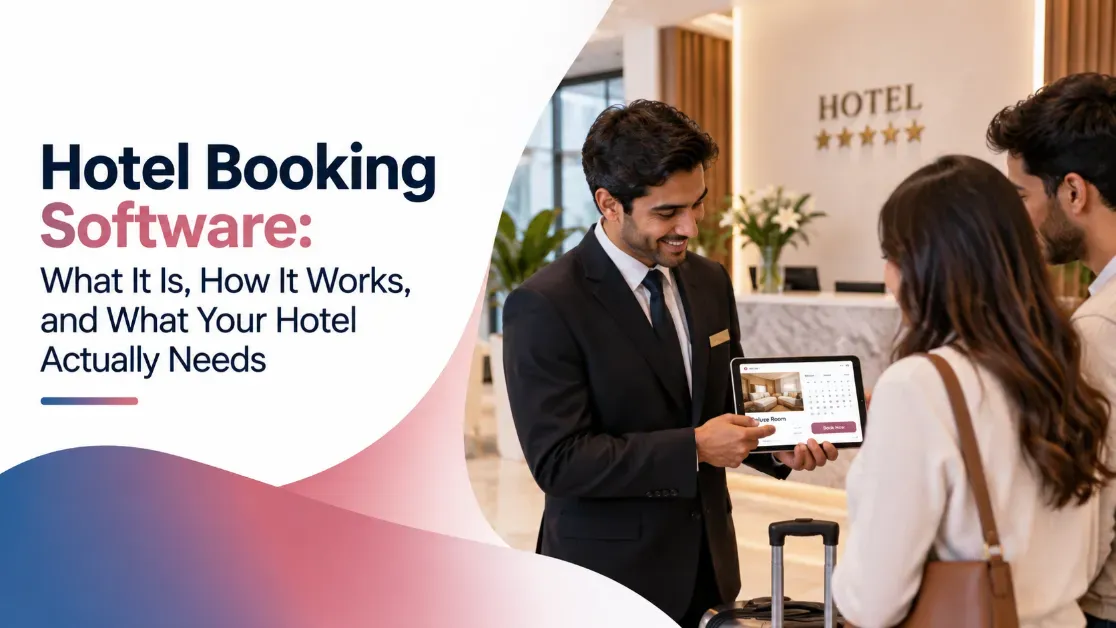
Hotel booking software is the system that lets guests reserve a room online, whether directly on your website or through an OTA, and keeps that reservation synced across every channel automatically. It exists to solve three specific problems: double bookings, revenue lost to OTA commission, and staff re-entering the same reservation by hand. Not every hotel needs the same version of it. A small property with mostly walk-in guests may not need one yet at all.
This kind of search usually means one of a few things: understanding what it actually is, seeing how it works day to day, or figuring out if your hotel needs it and which type fits.
This guide covers all of that in order, not just a feature checklist.
- What Is Hotel Booking Software?
- How Does Hotel Booking Software Work?
- Why Do Hotels Use Hotel Booking Software?
- Types of Hotel Booking Software
- Key Features to Look For
- Does Your Hotel Actually Need This?
- How Is It Different From How You're Booking Rooms Now?
- How to Choose the Right Hotel Booking Software
- What Happens If Your Hotel Skips This
- Bringing It Together
- Frequently Asked Questions
What Is Hotel Booking Software?
It's any system that lets a guest check room availability, see rates, and complete a reservation without a phone call or a front desk conversation.
It usually covers two connected jobs:
1. Taking the booking: through a booking engine on the hotel's own website, or through listings on OTAs like online travel platforms
2. Keeping that booking accurate everywhere: so the same room can't be sold twice across different channels
Some tools handle only one of these jobs. Others, especially those built into a full PMS, handle both along with front desk and billing.
How Does Hotel Booking Software Work?

Stripped of jargon, here's the actual sequence:
1. A guest books a room, either on the hotel's website or through an OTA.
2. The system updates availability everywhere else that room type is listed, within seconds.
3. The reservation is sent to the front desk system, so staff see it without retyping it.
4. Payment is processed and recorded against that specific booking.
5. The booking source (direct, or which OTA) is logged for later reporting.
This is meant to happen automatically. Whenever any step depends on a staff member manually checking or updating a separate screen, that's exactly where double bookings and lost time creep back in.
Why Do Hotels Use Hotel Booking Software?
Four reasons come up consistently, in order of how much they usually matter:
1. It prevents double bookings. A room sold on two channels at once usually ends in a refund, a moved guest, or a bad review. Real-time sync stops that before it happens.
2. It increases direct revenue. Every booking made through the hotel's own site instead of an OTA keeps a larger share of that revenue, since there's no OTA commission on it.
3. It removes manual data entry Without a connected system, someone is copying reservations from an OTA extranet into a register or spreadsheet by hand.
4. It shows where bookings actually come from. Clear reporting on direct versus OTA bookings makes it possible to judge whether a channel or a marketing spend is worth it.
Also Read: How to Increase Hotel Bookings Without Losing Profit to OTAs
Types of Hotel Booking Software
Not all of it does the same job. Three types come up most often:
1. A standalone booking engine: handles direct bookings on the hotel's own website only. It usually still needs a separate channel manager to sync with OTAs.
2. A channel manager: focused on syncing availability and rates across OTAs and other channels, sometimes with a booking engine included.
3. A PMS with a built-in booking and reservation module: combines booking, front desk, housekeeping, and billing in one connected system.
Knowing which type a piece of software actually is matters more than comparing feature lists, since two products can use the same name for very different jobs.
Also Read: PMS vs Channel Manager: What's the Difference and Do Hotels Need Both?
Key Features to Look For

Once the type is clear, these are the features that make the practical difference:
1. Real-time channel sync: the core way to avoid double bookings hotel software is meant to prevent. A room booked anywhere should disappear from every other channel within seconds.
2. A mobile-friendly booking flow: many guests book last-minute from a phone, and a clunky flow loses them mid-booking.
3. PCI DSS-compliant payment handling: protects guest card data and reduces liability, a baseline requirement rather than an advanced feature.
4. Multi-currency and multi-language support: matters for hotels with international guests, less so for a mostly local guest base.
5. Direct versus OTA booking reports: shows which channel is actually earning its commission and which one isn't.
6. Integration with your existing PMS: so a reservation doesn't need to be entered twice into two separate systems.
For a hotel investing in hotel direct booking software specifically, features 1 and 5 matter more than the rest, since the entire point is shifting revenue away from commission-heavy channels.
These are the hotel booking engine features that make a genuine difference in daily operations, not just in a sales demo.
Does Your Hotel Actually Need This?
Not every property needs the same setup, and it's worth being honest about that before spending on anything.
If your hotel fits the bottom two rows, this stops being a nice-to-have and starts being something that actively protects revenue.
How Is It Different From How You're Booking Rooms Now?
Most hotels without dedicated software book rooms one of three ways: by phone or WhatsApp, through a spreadsheet, or by manually updating each OTA extranet separately.
All three work, until they don't. The failure point is always the same: two people or two systems holding the same room at the same time, with no single source of truth.
This kind of system replaces that with one shared, real-time record instead. A phone booking, a WhatsApp inquiry, and an OTA reservation all update the same inventory, rather than living in separate places reconciled only at day's end.
How to Choose the Right Hotel Booking Software
A few direct questions separate software that solves your actual problem from one that just demos well:
1. What specific problem at my hotel would this solve, based on how I currently take bookings?
2. What type of system is this, a booking engine, a channel manager, or a full PMS module?
3. How fast does the sync happen between channels, in seconds or minutes?
4. Is PCI DSS compliance built in, or dependent on a separate payment provider?
5. Can I see a clear split between direct and OTA bookings in reporting?
6. Does it connect to my existing PMS, or does it require switching that too?
What Happens If Your Hotel Skips This
Skipping real-time sync means double bookings surface eventually, usually at check-in, which is the worst possible moment for both the guest and the front desk.
Skipping booking-source reporting means it's hard to tell whether an OTA relationship or a marketing spend is actually paying off, so decisions get made on guesswork.
Skipping payment compliance is the highest-risk gap of all. It's not about convenience, it's about exposure if guest card data isn't handled properly.
Bringing It Together
It isn't valuable because of a long feature list. It's valuable because it solves specific problems: rooms double-booked across channels, staff re-entering the same reservation twice, and no clear picture of where bookings actually come from.
If your hotel is dealing with any of those today, that's the real signal it's time to look at booking software, not the type of system or the feature list on its own.
FAQs
What exactly is hotel booking software?
Do I need hotel booking software if my hotel is small and mostly takes walk-ins?
How is hotel booking software different from taking bookings by phone or WhatsApp?
What's the real benefit of hotel booking management software for a small hotel?
Can hotel booking software work without a separate channel manager?
Related Posts

Hotel Management Software
What Software Is Used in Hotels? A Complete Guide to Every System, How It Works, and What It's For
29 Sept 2026
Hotel Management Software
Hotel Software for Hotel Owners: Features That Simplify Hotel Management
19 Sept 2026
Hotel Management Software
Hotel Management Software for 3-Star Hotels: Features That Matter
14 Sept 2026