
Hotel Management Software Features Every Modern Hotel Needs
By Foodle+ Team • 15 Sept • 17 MINS READ
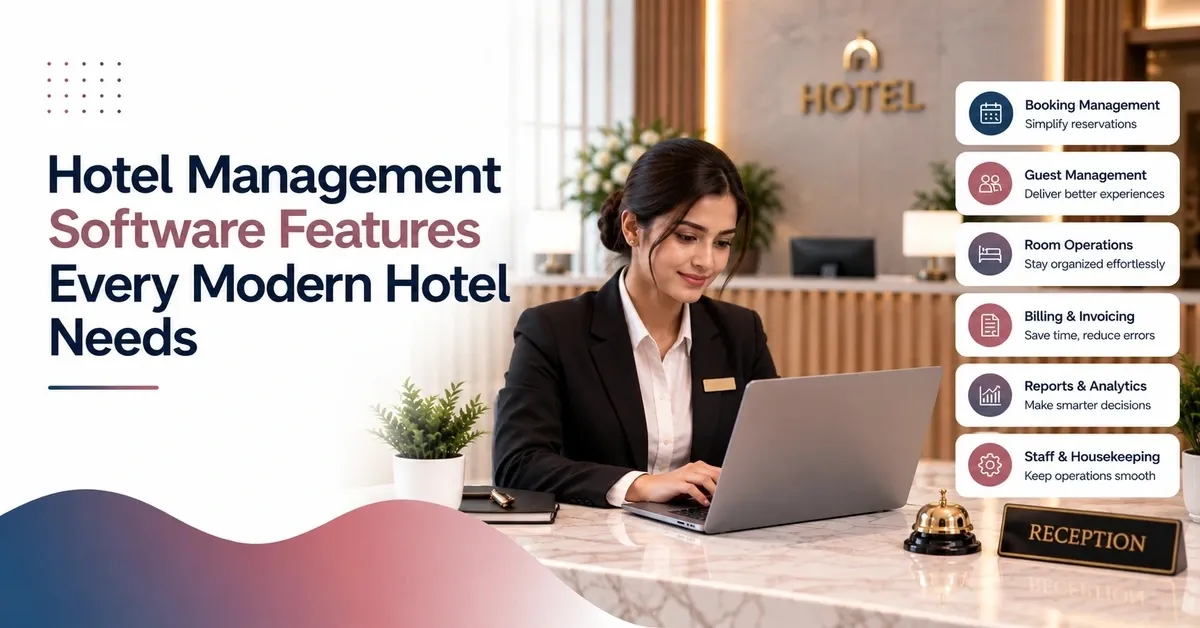
A modern hotel system has to do three jobs, not one. Run daily operations. Serve the guest while they are still inside the building. Earn revenue from guests already booked in.
Most feature lists only cover the first one.
Scroll through any software comparison and the same ten items show up in the same order. Reservations, channel manager, booking engine, housekeeping, billing, reporting. Useful stuff, all of it. But it stops at the front desk. The hotel management software features that decide whether a property earns more per guest sit deeper inside the stay, and almost nobody writes about those.
So this guide grades every feature by what a property uses on a shift. Not by how long the list runs. There is also a breakdown further down of which features matter at 15 rooms versus 80, because those are not the same purchase.
- What features does hotel management software actually need?
- Core operations features: front desk, reservations, housekeeping, and billing
- Guest experience features that work during the stay
- Revenue features that earn money from guests already in the hotel
- F&B and POS features for hotels with outlets
- Automation, AI and reporting features
- Where distribution features actually live
- Which hotel management system features matter at your property size
- How to check a feature is real before you sign
- FAQs
What features does hotel management software actually need?
A hotel system needs six feature areas to run a property end to end: front desk and reservations, housekeeping, billing with GST, in-stay guest service, in-house revenue tools, and reporting. Properties with a restaurant, bar or spa need point of sale as a seventh. Everything past that is optional.
Sounds short? It is. And it is deliberate.
Feature count is a terrible buying signal. A system with forty features and a slow front desk screen loses to a system with twenty that your night shift can operate without calling anyone. The hotel management software features worth paying for are the ones that map to something happening during a shift: a request routed, a room turned, an order placed, a bill closed cleanly.
Everything else is a line item on a comparison chart.
The time payoff is real and measured. HotelTechReport's 2026 Hotel PMS Impact Study, which surveyed 450 experienced operators, found that 89% of hoteliers save between 2 and 10 or more hours every week because of their system. Seventeen percent save more than ten hours weekly. That works out to over 500 hours a year, per property, handed back to a team that was previously reconciling things by hand.
Now the six areas, in the order a guest actually moves through them.
Core operations features: front desk, reservations, housekeeping, and billing
This is the base layer. Nothing else works without it, and every vendor competes here, which is exactly why it rarely decides the purchase. It is also where the night audit lives, the end-of-day process that closes the books and rolls the property into the next date.
Four things have to be solid:
- Front desk and room status. One screen showing today's arrivals, pending departures, walk-ins and room assignment. Your receptionist should read it in five seconds, not scroll for it.
- Booking and reservation management. Individual and group bookings, live room availability, automated confirmations, and a source tag on every reservation so you know which channel is actually feeding you.
- Housekeeping management. Live room status tied straight to the front desk. A checkout at 10:40 shows up on the housekeeping list at 10:40, without a phone call. Task assignment by staff member, maintenance flags, cleaning priority.
- Billing and payment management, with GST. Room charges, restaurant tabs, spa and add-ons consolidated into one accurate folio, which is the running bill attached to a guest's stay. GST billing configured correctly matters for every Indian property, and it is the one thing global software guides forget to mention. If card payments run through the system, PCI DSS compliance sits with whoever processes them, so ask where that responsibility lands.
Here is where the hours actually go missing. In a 40-room hotel where housekeeping calls room status in over a call and the front desk retypes it into a screen, the room list on the desk is always a few minutes behind the floor. Guests wait at reception for a room that has been clean since 10:20. That gap is not a staffing problem. It is a data problem, and these hotel PMS features exist to close it.
Get this layer right and it disappears into the background. Which is the point. The interesting decisions start once the guest is upstairs.
Guest experience features that work during the stay
Guest experience software features cover everything a guest can do from their room without calling reception: ordering food, requesting housekeeping, booking a service, raising an emergency alert, or leaving feedback before checkout. This is the layer most software comparisons skip completely, and it is where an independent property either feels modern or feels like 2015.
What belongs here:
- QR code ordering. The guest scans one QR in the room and orders dining or services from their own phone. No app download, no account creation. They stay logged in until checkout, so the second order takes four seconds instead of forty.
- Digital in-room menu. Updated once, centrally, live across every room. Compare that to reprinting laminated cards every time the kitchen drops a dish, or the old workaround of a QR pointing at a PDF on Google Drive that nobody has updated since March.
- Service request routing. A towel request goes to housekeeping. A leaking tap goes to maintenance. A late-night order goes to the kitchen. Automatically, tracked, with a timestamp on each one.
- Real-time guest to staff communication. The guest can see that the request was received and is being worked on. Most complaints are not about slow service. They are about silence.
- Multi-language guest portal. A resort in Goa or Rishikesh running a mixed domestic and international guest list needs this more than a city business hotel does.
- Guest SOS system. An emergency alert that locks the front office screen until a staff member acknowledges it. Not a notification someone can swipe away. A hard stop.
- In-stay feedback collection. The single most underrated feature on this list. Catching a complaint on day one of a three-night stay is a service recovery. Catching it after checkout is a public review you cannot edit.
That last point is worth sitting with. A property that fixes problems before departure protects its Google Business Profile and TripAdvisor ratings without spending a rupee on reputation management.
Revenue features that earn money from guests already in the hotel
Revenue features in a hotel system fall into two groups: rate and distribution revenue, which most guides cover, and in-house revenue, which almost none of them do. In-house revenue means everything a booked guest spends after check-in. Dining, upgrades, spa, celebrations, late checkout, activities.
The distinction shows up in the numbers hoteliers already track. ADR is your average daily rate, what a room sells for. RevPAR spreads room revenue across every available room. Neither one counts the dinner. TRevPAR, total revenue per available room, does, and that is the number this section moves.
The same HotelTechReport study found that 91% of hoteliers link their system directly to revenue growth, specifically through automated upsells and pricing. Rate is only half that story.
The features that pull the other half:
- Smart upselling. Offers built from the guest profile, stay length and past spending, not a blanket promo shown to everyone. A couple on a two-night stay sees a private dinner setup. A family sees a kids' meal package. Different guests, different screens.
- Cross-department selling. The restaurant promotes the spa. The spa promotes a dining package. The front desk promotes paid late checkout. Most hotels run these departments as separate islands, and each one quietly leaves money with the other.
- Guest CRM. Stay history, room preferences, spending patterns and feedback attached to one guest record. This is the asset. Everything else in this section runs on it.
- Off-season remarketing. Using those guest records to bring past guests back directly during low-demand months. Reaching someone who already stayed with you costs a fraction of what OTA commission costs to acquire a stranger.
- Revenue dashboard. Room revenue plus ancillary revenue, split by department, live. Without it you are guessing which services are actually profitable.
Chasing occupancy alone is the trap. Two properties can sell the same number of room nights and end the month in completely different places, because one of them sold dinner, a spa slot and a late checkout on top and the other sold a bed.
F&B and POS features for hotels with outlets
Hotel POS features handle everything your restaurant, bar, spa or room service generates: order management, kitchen coordination, inventory tracking, outlet billing, and posting those charges to the guest folio automatically.
Most guides treat point of sale as an integration footnote. For an Indian resort that is backwards. Food and beverage is usually the second revenue line after rooms, and it generates far more daily transactions than the front desk does.
The failure mode is easy to picture. A guest eats at the restaurant on Tuesday, books a spa slot on Wednesday, orders room service on Thursday, and checks out Friday morning while your finance team is manually matching three systems against one folio. Every mismatch is either a billing argument at the desk or revenue you never collected.
Run the F&B module on the same system as the room record and that reconciliation stops being a task.
Automation, AI and reporting features
Automation features decide who does the work of coordination. Without them, a duty manager spends the shift relaying information between departments. With them, the system routes it and the manager handles exceptions.
What to look for:
- Automatic task routing to the correct department, with status tracking on every task
- Automated service and order workflows so nothing sits in someone's memory
- AI-generated reports on usage patterns, guest behaviour and revenue performance
- Analytics covering service operations, sales, and staff task completion
The market is moving this way fast. In the same 2026 study, 49% of hoteliers named AI-powered automation and personalisation as what they most want vendors to build next. It is now a shortlist criterion, not a differentiator.
But be sceptical of the word AI in a demo. Ask what it produces. A useful answer sounds like "it flags which add-on services sold below their three-month average this week." A useless answer sounds like "it uses machine learning."
An owner should be able to open one screen and see occupancy, ADR, RevPAR, revenue by department, most-sold services, slowest service response times, and which staff member cleared their tasks. If a report needs a spreadsheet export to become readable, it is not a report.
Where distribution features actually live
Worth being straight about this, because it saves buyers a lot of confusion.
OTA distribution, rate parity across Booking.com and MakeMyTrip, and selling rooms to the public from your website are the job of a channel manager and a booking engine. Those are separate software categories from a hotel operations platform. A system that claims to be all of them at once is usually thin at several of them.
Knowing which box a product belongs in is half of a good shortlist. Ask any vendor directly whether distribution is native or partner-led, and treat a vague answer as an answer.
Which hotel management system features matter at your property size
Not every property needs every module on day one. What makes sense for a 200-room resort can be dead weight at 18 keys. Paying for multi-property architecture while your billing screen is slow is the most expensive mistake in this category.
Homestays surprise people on this table. With no front desk to call, the digital ordering and request layer is not a luxury for them. It is the front desk. And because homestay repeat business lives or dies on ratings and returning guests, the guest records matter more there than at a 200-room hotel with constant walk-in traffic.
Check this against your own floor plan, not against a competitor's checklist.
How to check a feature is real before you sign
Demos are performances. Sample data, a practised presenter, and a workflow chosen because it looks good. Your Tuesday morning is none of those things.
Six questions that get past the polish:
1. Run the property's actual flow. Real room types, real rate plans, a checkout going to housekeeping. Not the demo property.
2. What happens to a guest's in-room order if the internet drops for ten minutes?
3. Is this feature on the plan being quoted, or is it an add-on? Get it in writing.
4. Who raises the API request with the existing PMS provider, and who pays if that provider charges for it?
5. What does data export look like on the day a hotel leaves? Full guest database, standard format?
6. How long before a new front desk hire can work a shift unsupervised?
That last one has a benchmark. HotelTechReport found 92% of operators say modern interfaces cut onboarding from weeks to days. If a vendor quotes you two weeks of training, that is information about the software.
One more thing worth knowing. Switching your whole system is not the only path. A guest experience and revenue layer can run alongside an existing PMS through a light API sync, a scheduled data sync, or fully standalone with no PMS dependency at all. Plenty of properties start standalone, prove the revenue, and integrate later.
FAQs
What are the main features of hotel management software?
What is the difference between a hotel PMS and a hotel management system?
Do small hotels and homestays need hotel management software?
Can hotel management software work with the PMS a hotel already uses?
Which hotel management software features increase revenue?
How long does it take staff to learn a new hotel management system?
Related Posts
Hotel Management Software
Hotel Software for Hotel Owners: Features That Simplify Hotel Management
19 Sept
Hotel Management Software
Hotel Management Software for 3-Star Hotels: Features That Matter
17 Sept
Hotel Management Software
Hotel Management Software for 5-Star Hotels: Essential Features to Consider
17 Sept