
How Can a Hotel Earn More From Each Guest Without Raising Room Rates?
By Foodle+ Team • • 13 MINS READ
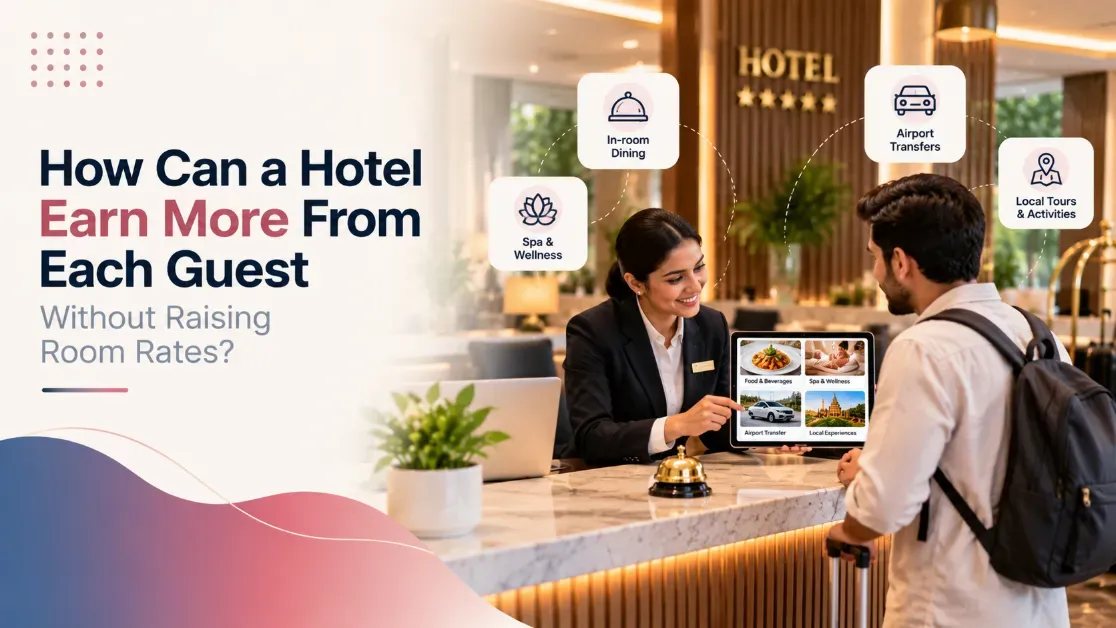
Quick Answer: A hotel earns more from each guest by selling more to the guests already staying, not by charging more for the room. Work out your revenue per occupied room, pick three or four offers your guests already want, such as late checkout, dinner and one experience, make them at the right moment, and track what sells every week.
Room rates in India have already gone up. Horwath HTL's India Hotel Market Review 2025, reported by TravTalk, puts the average daily rate at ₹8,624, up 8.6%, with occupancy at 64%. That is a market average, so your own numbers will differ. But if you run a smaller hotel, you know how hard it is to push the rate any further when guests compare prices on their phones.
The guest who has already booked is a different story. They are in your building, they need to eat, they want a later checkout, and some of them are celebrating something. An FHRAI survey of 475 hotels, reported in February 2019, found that food, beverage and banquets made up 42.3% of Indian hotel revenue in 2017-18. The data is old, but it shows how much money sits outside the room rate.
This guide shows how to measure revenue per guest, what to sell, when to ask, what your team can say, and four numbers to track. You can start most of it this week with the team you have.
- What Is Revenue Per Guest, and How Do You Measure It?
- What Can You Sell to Guests Who Are Already in the Hotel?
- What Do Guests Actually Pay For?
- When Should You Make the Offer?
- What Should Your Team Say?
- Which Offers Should a Small Hotel Start With?
- How Does Foodleplus Help You Earn More From Each Guest?
- What Should You Track to Know It Is Working?
- So, Where Should You Start?
- Frequently Asked Questions
What Is Revenue Per Guest, and How Do You Measure It?
Revenue per guest is everything a guest spends with you, not only the room. The easiest way to measure it is total revenue divided by occupied rooms for the same period. Add room, food, beverage, spa and extras, then divide. Per guest is the ideal, but per occupied room is easier to pull from your bills. Most hotels watch only occupancy and room rate, so they never see the rest.
Here is an illustration with round numbers, not a benchmark. Say your hotel has 20 occupied rooms on a day. Rooms bring in ₹80,000, food and beverage ₹18,000, and extras ₹2,000. That is ₹1,00,000 in total, or ₹5,000 per occupied room.
Now add ₹300 per occupied room from late checkouts, dinners and one activity. That is ₹6,000 a day, or about ₹1.8 lakh over a 30-day month. Your room rate did not change. Your revenue is up 6%.
There is a longer version of this idea called TRevPAR, or total revenue per available room. You get it by dividing total net revenue by the rooms you have available to sell. It also counts rooms that sat empty, so it shows how well the whole property earns. For a first pass, revenue per occupied room is easier, because you can work it out from your bills in ten minutes.
What Can You Sell to Guests Who Are Already in the Hotel?
You can sell anything a guest might want during the stay that costs you little extra to give. The best offers use things you already have: a room that is free late, a restaurant that is quiet at lunch, a spa with open slots. Seven offers cover most hotels, and each one has a natural moment.
Not every hotel needs all seven. A small city hotel may do well with late checkout and room choice. A resort has more to offer through spa, activities and dining. Pick based on what you have spare, not on what sounds good.
What Do Guests Actually Pay For?
Guests pay most readily for choice and for time. In a study by a hospitality software provider, published on Hospitalitynet in November 2022, 54% of consumers said they would pay more to choose their view, 38% to choose their room and 32% to choose their floor. The article does not give the sample size, and its author works at the company that ran it, so treat these as signals, not forecasts.
The pattern is still useful. Choosing a room with a better view or a quieter floor costs you nothing extra to deliver, because the room is already built. Late checkout is the same. If the room is not booked that night, an extra two hours costs you very little and means a lot to a guest who has a late flight.
Food works differently. Guests are hungry at fixed times, and many do not want to leave the property after a long day. If your menu is easy to find and easy to order from, a share of them will order. If it needs a phone call to an unclear extension, most will not bother.
When Should You Make the Offer?
Make the offer when the guest is already thinking about it. The same offer can feel like a pitch or like help, depending on when you say it. Four moments cover most of a stay.
- Check-in day. This is the best time for room choice, a dinner add-on and your breakfast plan. The guest has just arrived, wants to settle in, and is still deciding how to spend the evening.
- The first evening. Guests are tired and hungry. A short menu of dinner and in-room options works well here.
- Day two. Guests who are staying more than one night often have a free morning. This is the time for a spa slot, a local tour or a celebration setup.
- The evening before checkout. Late checkout, an airport transfer and a packed breakfast fit here, because the guest is planning the last day.
Keep it to one offer at a time. A guest who gets three offers in a minute remembers none of them.
What Should Your Team Say?
Your team should ask a simple question and accept a no. Staff who sound like they are reading a script lose the sale, and staff who push lose the guest's goodwill. Plain, short lines work best, and they should sound like your front desk, not like a brochure.
- Late checkout: "Your flight is in the evening, right? I can keep the room until 3 PM for a small fee, if you'd like."
- Room choice: "I have a room on the fourth floor facing the hills. Would you like it instead?"
- Dinner: "Our restaurant has a Rajasthani thali tonight. Shall I book a table for 8?"
- Celebration: "Is this trip for a special occasion? We can set up a cake and flowers in the room."
A few simple rules help.
- Ask once, then move on. If the guest says no, say "no problem" and mean it.
- Use the guest's own words. If they mention a flight, an anniversary or kids, build the offer around that.
- Know the price and the cut-off time before you speak. A vague answer kills the sale.
- Tell your team that you track add-on sales as a team number, not as a personal score. This keeps the offers honest.
Which Offers Should a Small Hotel Start With?
Start with three: late checkout, one dining offer and one experience. Three is enough to learn from and few enough that your team can remember them. You can add more once the first three run smoothly for a few weeks.
- Pick an offer that costs you almost nothing to deliver, such as late checkout on days when the room is not booked.
- Pick one dining offer that uses a slow time, such as an early dinner or a lunch combo.
- Pick one experience your property already has, such as a spa slot, a guided walk or a bonfire evening.
- Write the price, the time limit and the staff member who handles each on one page.
- Put that page at the front desk and in the restaurant, so everyone gives the same answer.
- Review after two weeks. Drop what nobody bought and keep what sold.
Do not discount the room to sell an extra. If you want to bundle, keep the room at its normal rate and add a small saving on the extra, such as a dinner. This protects your room rate while still giving the guest a reason to say yes.
How Does Foodleplus Help You Earn More From Each Guest?
Foodleplus Smart Upselling shows each guest personalised offers by guest type and moment, such as room upgrades, dining and spa. Guests scan the QR code in their room and see the offers on their phone, with no app to download. When a guest picks one, the request goes to the right staff and is tracked in real time.
Because Foodleplus POS posts restaurant, spa and service charges to the guest folio, the charges show up in one bill at checkout. The reports show which services sold, so you can see which offers to keep. In a Foodleplus case study, a hotel saw guest spend rise by 30%. Results depend on the property, so a demo on your own services is the best way to judge it.
For more on the ideas behind this, read the difference between cross-selling and upselling in hotels, see how the Smart Upselling feature works, and learn how digital menu ordering can lift room service sales.
What Should You Track to Know It Is Working?
Track four numbers every week. They are revenue per occupied room, how many guests accept each offer, add-on revenue by offer, and what guests say about the offers. Look at them on the same day each week, and compare with the week before, not with a target you guessed.
- Revenue per occupied room. Total revenue for the week divided by occupied rooms for the week. This is your main number.
- Acceptance rate. For each offer, the number of guests who said yes divided by the number you asked. A low rate means the offer, the price or the moment is wrong.
- Add-on revenue by offer. Which of your offers earns the most. Keep the top ones and rethink the rest.
- Guest comments. Read feedback for words like "pushy" or "helpful". Add-on sales should never cost you your rating.
Do not set a target in the first two weeks. Collect the numbers, then pick the one offer with the biggest gap between asked and accepted.
So, Where Should You Start?
You do not need new software to start earning more from each guest. This week, work out your revenue per occupied room, pick three offers, write the price and cut-off on one page, and teach your team two or three plain lines. Then count what sells for two weeks. That tells you what to keep, what to drop and where to add next.
FAQs
Why Are Hotel Rooms Not Ready at Check-in?
How Much Time Does a Hotel Really Have to Turn a Room?
How Do You Fix Rooms Not Being Ready?
What Should the Front Desk Say When a Room Isn't Ready?
What Should You Track to Know It's Working?
Related Posts

Hospitality
How Can Hotels Handle Language Barriers With Foreign Guests?
12 Nov 2026
Hospitality
What Is FRRO Form C, and How Do Hotels Register Foreign Guests?
12 Nov 2026
Hospitality
Do Homestays Need a PMS? A Simple Guide for Guest Houses
11 Nov 2026