
What Is Night Audit in a Hotel? (Steps and Checklist)
By Foodle+ Team • • 10 MINS READ
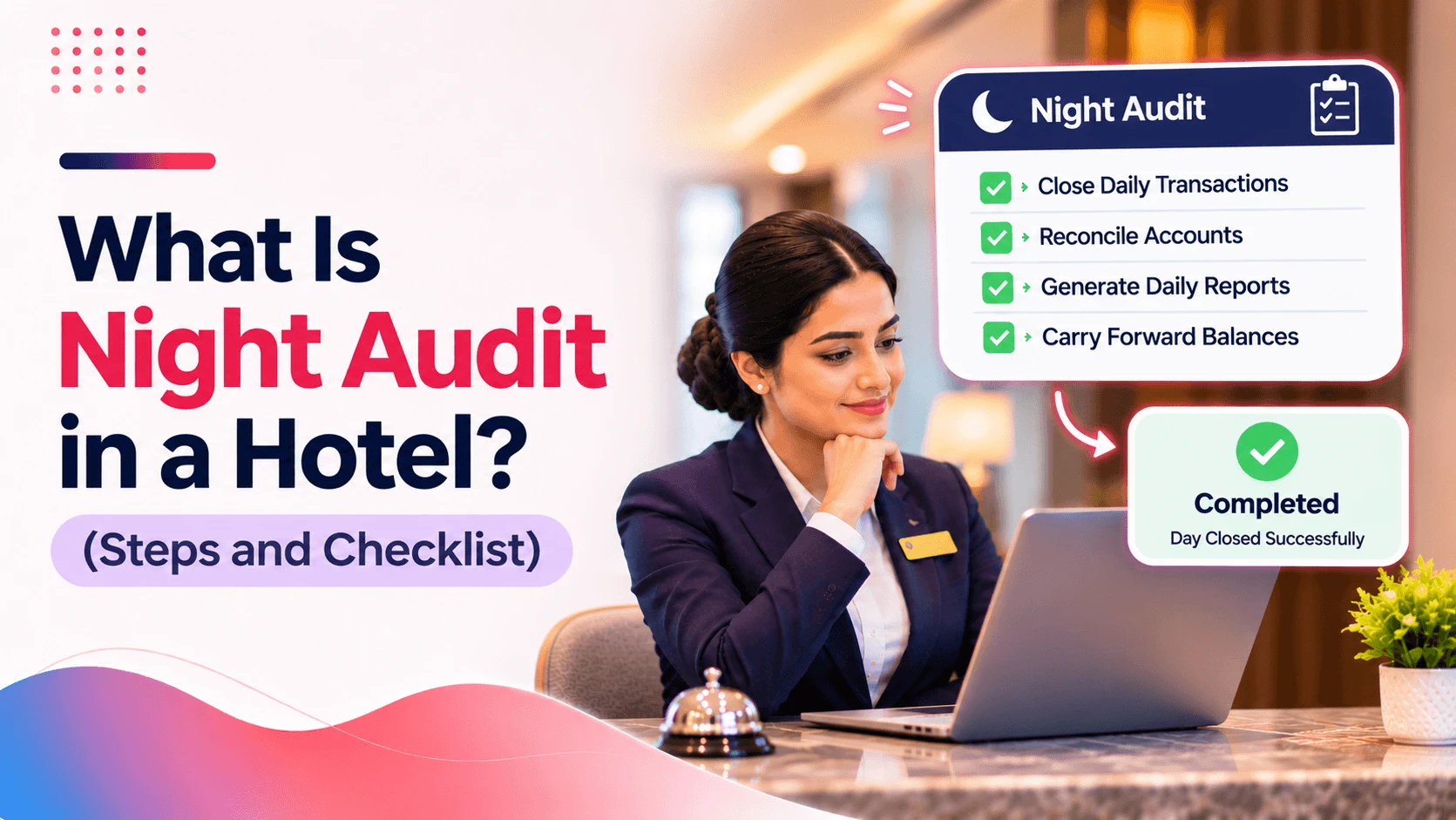
Quick Answer: A night audit in a hotel is the job of closing the hotel's day, every night. The night staff post room charges to every guest's bill, match cash, card and online payments against the system, sort out guests who never arrived, and then move the hotel's system to the next date. Last, they print reports for the morning team.
It's 1:10 am. The lobby is quiet, the last guest came back from dinner an hour ago, and the system still says it's yesterday.
That's the moment night audit starts.
If you're new to the front desk, it can feel like a big scary accounting job. It isn't. It's a fixed list of checks, done in the same order every night. Once you know the order, most nights take 30 to 60 minutes. The bad nights are the ones where something doesn't match, and we'll cover those too.
- What Is Night Audit in a Hotel?
- When Does Night Audit Happen and How Long Does It Take?
- How to Do a Hotel Night Audit: Step by Step
- Night Audit Checklist
- Which Reports Come Out of a Night Audit?
- What to Do When the Numbers Don't Match
- Night Audit Mistakes Front Desk Teams Make
- Can Software Make Night Audit Faster?
- FAQs
- Close Tomorrow's Day Better
What Is Night Audit in a Hotel?
Night audit is the daily check that makes sure every rupee, dollar or dirham the hotel earned today is posted correctly before the day is closed. It's done at night because that's when check-ins, check-outs and restaurant bills have mostly stopped.

Think of it like a shop owner counting the cash box before locking up. Except a hotel has more boxes: rooms, restaurant, bar, room service, laundry, card machines and online payments.
A few words you'll hear a lot:
- Business date:: the date the hotel's system thinks it is. It doesn't change at midnight on its own. It changes only when the night audit is finished.
- Guest ledger:: the list of money owed by guests who are staying right now.
- Posting:: adding a charge to a guest's bill, like tonight's room rent or a dinner sent to Room 204.
- No-show:: a guest who booked but never arrived.
In bigger hotels, a person called the night auditor does this. In most mid-size and boutique properties, it's whoever is on the desk at night. Often that's one person handling the phone, the keys and the audit all together.
When Does Night Audit Happen and How Long Does It Take?
Most hotels run night audit between midnight and 2 am, after the restaurant and bar have closed. Wikipedia's note on the night auditor role puts the usual close of business in that same window.
How long it takes depends on your setup:
| Your setup | Usual time |
|---|---|
| Paper register and a separate billing machine | 2 to 3 hours |
| Hotel software, but restaurant billing on a different system | 1 to 2 hours |
| Hotel software and restaurant billing connected | 30 to 60 minutes |
These are rough ranges from how front desks usually work, not a rule. The real time-killer is never the clicking. It's chasing a ₹1,200 difference at 2 am.
How to Do a Hotel Night Audit: Step by Step
Here's the hotel night audit process in the order most front desks follow. Don't skip around. The order matters because each step depends on the one before it.
| Step | What you do | Why |
|---|---|---|
| 1. Take the handover | Read the logbook, count the cash float, note any pending issues from the evening shift | You start with a clean, known amount |
| 2. Close the outlets | Make sure the restaurant, bar and room service have closed their bills for the day | Late bills posted after audit end up on the wrong date |
| 3. Check arrivals | Look for guests still marked "arriving today" | Decide who is a no-show and who is just late |
| 4. Check departures | Look for guests still marked "leaving today" | A guest who left but wasn't checked out keeps getting charged |
| 5. Check room rates | Compare each occupied room's rate with the booking | Catches wrong rates, missing discounts and zero-rate rooms |
| 6. Post room charges | Add tonight's room rent and tax to every occupied room | Most software does this automatically when you run the audit |
| 7. Match payments | Match cash, card machine totals and online payments with the system | This is where most differences show up |
| 8. Run the day close | Back up, then run end of day in your software to move to the next business date | The new day starts clean |
| 9. Print or send reports | Share the morning reports with the manager and accounts | The morning team starts with the right numbers |
A few notes that the table can't hold.
On step 3: call the guest or the booking source before marking a no-show. A late flight is not a no-show. If the booking is guaranteed with a card, follow your hotel's no-show charge policy.
On step 7: card machines need a "batch close" or "settlement" every night. Then the total on the machine's slip should match the card total in your system. Do the same for UPI, wallet or bank-transfer payments if your hotel takes them. Count cash last, after you've sorted the cards, so you're not counting twice.
On step 8: never run day close while a difference is still open. Once the date moves, fixing yesterday gets much harder. This end of day guide from Setup My Hotel also puts a final pre-close check right before this step, and it's a good habit.
Night Audit Checklist
Print this and keep it at the desk. Tick it every night.

Before you start
- [ ] Logbook read and pending issues noted
- [ ] Cash float counted and signed
- [ ] Restaurant, bar and room service bills closed for the day
Rooms
- [ ] No guests left in "arriving today" without a decision
- [ ] No guests left in "leaving today" who have actually gone
- [ ] Room rates checked against bookings
- [ ] Zero-rate and complimentary rooms approved by a manager
- [ ] Room status on the system matches what's really occupied
Money
- [ ] Every outlet bill charged to a room shows on that guest's bill
- [ ] Card machine batch closed and matched with system total
- [ ] Online and digital payments matched
- [ ] Cash counted, matched and dropped in the safe
- [ ] Every difference explained and written in the logbook
Close
- [ ] System backed up
- [ ] Day close run, new business date showing
- [ ] Reports sent to the manager and accounts
Which Reports Come Out of a Night Audit?
The night audit report isn't one report. It's a small set, and each one answers a different question for someone in the morning.
| Report | What it shows | Who reads it |
|---|---|---|
| Daily revenue report | Room, restaurant and other income for the day | Owner, GM, accounts |
| Occupancy report | Rooms sold, rooms empty, average room rate | GM, revenue or sales person |
| Payment report | Money received by cash, card and online | Accounts |
| Guest ledger | What each in-house guest owes right now | Front office manager |
| No-show and cancellation list | Bookings that didn't turn up | Reservations, sales |
| Rate check report | Rooms sold below the normal rate | GM |
If your owner only reads one, it's usually the daily revenue report. Make that one right first.
What to Do When the Numbers Don't Match
This is the part nobody teaches, and it's the part that ruins nights. Most differences come from a short list of reasons.
| What you see | Most likely reason | What to do |
|---|---|---|
| Card machine total is higher than the system | A card payment was taken but not entered in the system | Match each slip with a bill until you find the missing one |
| System total is higher than the card machine | A payment was entered as "card" but was actually cash or online | Check the payment type on the last few bills |
| Cash is short | Change given wrong, or a payout not written down | Check payouts and refunds first, then recount |
| Restaurant total doesn't match room charges | A dinner bill wasn't moved to the guest's room | Find the restaurant bill, post it to the right room |
| A guest has a bill but no room rent | Room was marked empty by mistake | Fix the room status, then post the rent |
If you can't find a difference in 20 minutes, write it in the logbook with the exact amount and move on. Hiding a ₹500 gap so the report looks clean is far worse than reporting it. The morning manager can fix it with fresh eyes. You can't, at 3 am.
Night Audit Mistakes Front Desk Teams Make
- Running day close too early.: A late room service order then lands on tomorrow's date.
- Not checking departures.: The guest left at 7 pm, nobody checked them out, and the system charges them another night.
- Marking late arrivals as no-shows.: Then the guest walks in at 2 am and their room is gone.
- Ignoring small differences.: ₹200 tonight becomes a habit, and a habit becomes a real leak.
- Skipping the backup.: If the system fails during day close, you lose the day's work.
- No handover note.: The morning team has to guess what happened.
Honestly, the first two cause more trouble than everything else on this list.
Can Software Make Night Audit Faster?
Yes, mostly by cutting out the copying. When the restaurant, bar and room service bills go straight onto the guest's room bill, there's nothing to re-enter at night. When room rent posts on its own, step 6 takes seconds.
What software can't do is decide for you. A person still has to call the late arrival, count the cash and explain a difference. So look for tools that make the matching easy, not ones that promise "no audit at all".
If you're comparing systems, this guide on cloud PMS vs traditional PMS explains the difference in plain words. And if you want to see what a full property management system for hotels covers, start there.
FAQs
What is a night audit in a hotel?
How long does a night audit take?
What happens if you skip the night audit?
What is the business date in a hotel?
Can a night audit be done during the day?
Close Tomorrow's Day Better
You don't need to fix everything tonight. Print the checklist, follow the steps in order, and write down every difference you can't solve. Do that for two weeks and the night audit in your hotel will stop feeling like a test and start feeling like a routine.
Related Posts

Hospitality
How Can Hotels Handle Language Barriers With Foreign Guests?
12 Nov 2026

Hospitality
What Is FRRO Form C, and How Do Hotels Register Foreign Guests?
12 Nov 2026

Hospitality
Do Homestays Need a PMS? A Simple Guide for Guest Houses
11 Nov 2026