
How to Track Maintenance Requests in a Hotel: A Simple System That Works
By Foodle+ Team • • 12 MINS READ
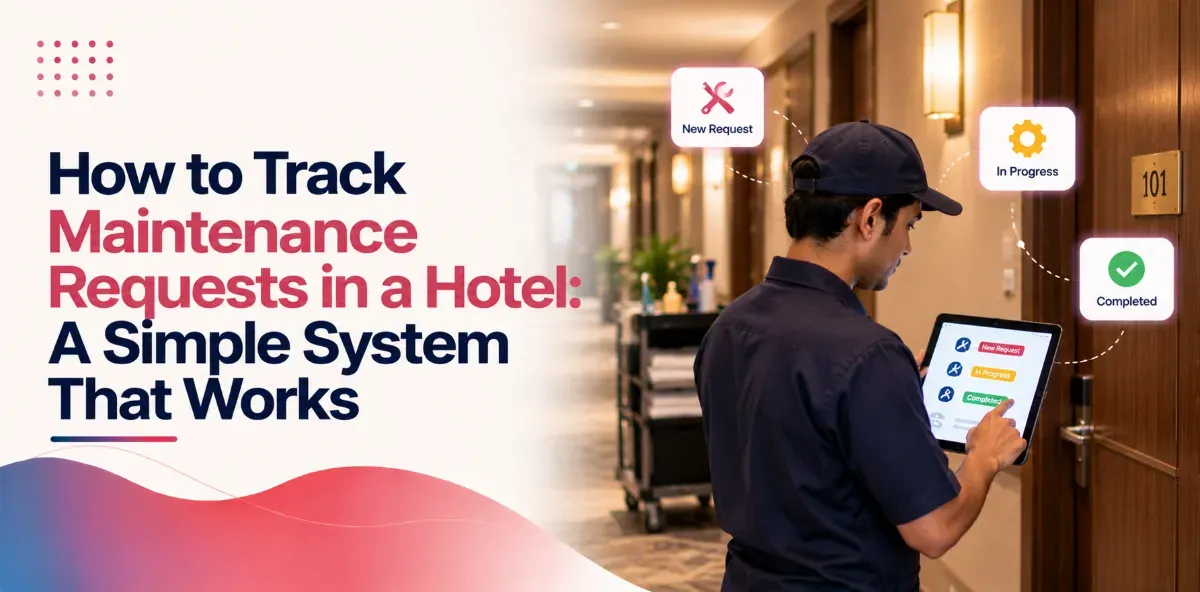
Quick Answer: To track maintenance requests in a hotel, write every problem down as one ticket in one shared place. Each ticket needs the room, the problem, the time and one person who owns it. Mark how urgent it is. Let only the person who fixed it close it, and link any blocked room to room status.
Imagine this. It's 11 pm and a guest tells the night desk, "My bathroom tap keeps dripping." The receptionist says, "Sure, I'll tell maintenance." But maintenance left at 8 pm. So she tells the guard, and the guard forgets. Next evening, a new guest is in that room and the tap is still dripping.
Nobody was lazy. The message just lived in someone's head, and heads forget. The fix is simple: write it down, give it an owner and check it every day.
So here's how to track maintenance requests in a hotel, step by step. Easy words, no fancy stuff.
- How Do You Track Maintenance Requests in a Hotel, Step by Step?
- What Should Every Maintenance Request Include?
- How Fast Should Each Maintenance Request Be Fixed?
- What Do You Do With a Room That Can't Be Sold?
- Which Numbers Should a Hotel Manager Watch Every Week?
- How Can You Stop the Same Repairs From Coming Back?
- Why Do Maintenance Requests Get Forgotten?
- Where Should You Start This Week?
- Frequently Asked Questions
How Do You Track Maintenance Requests in a Hotel, Step by Step?
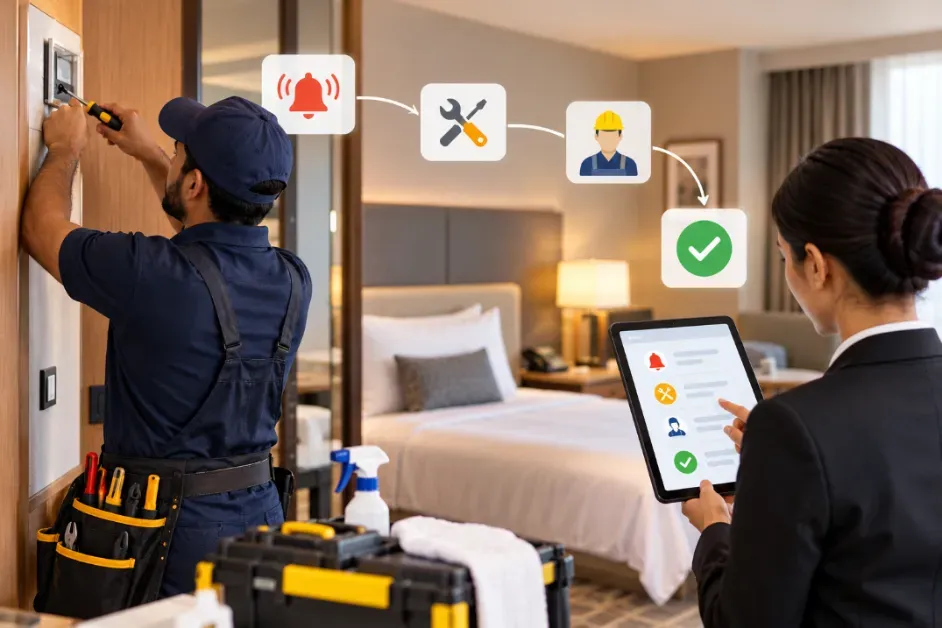
The whole idea is simple. Every problem becomes one ticket, and every ticket has one owner until it's fixed and checked. A ticket (also called a work order) is just a written job card. It says what is broken, where it is and who will fix it.
Here are the steps, in the order to do them.
- Pick one place where every request goes.: A shared sheet, a register kept at the front desk or a software tool all work. Give it a name, like "Repair Log". Then make one rule: if it isn't in the log, it doesn't exist. Not in a chat group, not in someone's memory. If a request comes by phone or radio, the person who took it writes it in the log right after the call.
- Write each problem as a ticket.: Add the six facts from the table in the next section: place, problem, who reported it, time, urgency and a photo. Keep it short. "AC issue" is too vague. "Room 308, AC blowing warm air, guest is in the room" is clear enough for anyone to act on.
- Give the ticket one owner and a deadline.: Write one person's name, not a department. "Maintenance" can't fix a tap, but Raju can. Add a time by which it should be done. If two people share a job, each one assumes the other has it. If the owner is off duty, the desk gives the ticket to someone else the same day.
- Choose the urgency.: Ask two quick questions. Is it unsafe? Can the guest still use the room? If it's unsafe, it's urgent, and the urgency table below tells you how fast to move. This stops the loudest voice from always going first.
- Update the room status if the guest can't use the room.: If a repair blocks a room, mark it so the front desk doesn't sell it. The section on blocked rooms below explains how.
- Fix it, check it, then close it.: The technician moves the ticket from open to in progress to fixed, and adds a photo if possible. Then someone else checks the room, like the desk or housekeeping. Only after that is the ticket closed. A guest going quiet doesn't mean the problem is solved.
- Read the open list every day.: Take ten minutes at the same time each day, for example at shift handover. Look at the oldest ticket, anything stuck while waiting for a spare part, and anything that needs a new deadline. The night person should read the list before leaving, and the day person should read it on arrival.
What does one request look like from start to finish?
Go back to Room 214. This time, with a system in place:
- 11:05 pm:: The guest tells the night desk about the dripping tap. The receptionist writes a ticket: place, problem, time, urgency "same day", owner Raju, deadline 5 pm.
- 8:00 am:: The day team reads the open list at handover. Raju sees the ticket right away. Nobody had to remember anything.
- 11:00 am:: Raju fixes the tap, adds a photo and marks the ticket fixed.
- 12:00 pm:: Housekeeping checks the room, sees the tap is dry and closes the ticket.
- Evening:: The night desk sees it's closed and tells the guest it's done. The guest feels heard.
Same problem, same people. The only difference is a written ticket with a name on it.
Requests will come from many doors. A guest tells the desk. Housekeeping spots a cracked tile. A waiter sees a leaking tap. The owner notices a flickering light. Every one of them goes into the same list.
What Should Every Maintenance Request Include?

Six facts. If a ticket carries these, the technician can act without calling anyone to ask.
| What to write | Why it matters | Example |
|---|---|---|
| Room or place | The technician goes to the right door | Room 214, bathroom |
| What is wrong | One clear line, no guessing | Tap keeps dripping |
| Who reported it | So someone can ask a question | Night desk, for the guest |
| Date and time | Shows how long it has waited | 30 Oct, 11:05 pm |
| How urgent | Big problems go first | Same day |
| A photo | Shows the fault without a long note | Photo of the tap |
A good ticket reads like this: "Room 214, bathroom tap drips non-stop. Reported by night desk at 11:05 pm. Guest stays two more nights. Urgency: same day. Owner: Raju. Status: open."
Short. Clear. Nothing to guess.
How Fast Should Each Maintenance Request Be Fixed?
It depends on two things: how much the problem hurts the guest, and whether it's unsafe. Four levels are enough for most hotels.
| Level | What it means | Examples | Starting target |
|---|---|---|---|
| Urgent | Unsafe, or the guest can't use the room | No water, sparks from a switch, door won't lock | Start within 30 minutes |
| High | Guest is in the room and uncomfortable | AC not cooling, no hot water | Fix within 2 to 4 hours |
| Normal | Annoying but the stay can go on | Dripping tap, loose handle | Fix the same day |
| Low | Only looks bad | Chipped paint, scuffed chair | Within a week, when the room is empty |
These times are a starting point, not a rule from any authority. Change them to fit your team size and busy season. For anything that could hurt someone, such as a gas smell, follow your hotel's safety plan first and log the ticket after.
What Do You Do With a Room That Can't Be Sold?
If a repair stops a room from being used, the ticket must change the room's status. Then the front desk won't sell it by mistake.
Two terms help here. Hotels use them a little differently, so agree on your own meaning and teach it to every shift.
- Out of order: usually means the room can't be used because of a repair, like a broken pipe. It comes off the list of rooms you can sell.
- Out of service: usually means a short stop, like a deep clean or a small fix that will finish today.
Without this link, you get a nasty scene. The desk sells Room 214, the guest walks in at 9 pm, and the leak is still there. Now you must find another room, say sorry and maybe offer a free dinner. One small step, a status change, would have saved all of it.
Which Numbers Should a Hotel Manager Watch Every Week?
Start with five. More than that and nobody reads the report.
| Number | What it tells you | How to find it |
|---|---|---|
| Open requests | How big the pile is | Count tickets not yet closed |
| Oldest open request | Who is waiting the longest | Check the earliest date on the list |
| Average time to fix | How fast the team really is | Add up the hours from report to done, then divide by the number of tickets |
| Repeat faults | Where the real problem hides | Same room, same fault, more than once |
| Nights lost to blocked rooms | What the delay costs you | Rooms blocked, times the nights |
If the oldest request gets older every week, the problem isn't speed. It's that nobody owns it.
How Can You Stop the Same Repairs From Coming Back?
Read your old tickets. If Room 308's AC shows up four times in two months, that isn't bad luck. Something deeper is wrong, and it needs a proper fix or a replacement.
The other half is preventive maintenance. That means checking things on a schedule, before they break. A simple hotel maintenance checklist for one room can include:
- Taps and drains: any drip or slow water?
- Bulbs and switches: all working?
- Door lock and latch: smooth and firm?
- AC filter and remote: clean and responding?
- Geyser: heating well?
- TV and Wi-Fi sockets: working?
- Bathroom smell or damp patches: any sign of a hidden leak?
Check a few rooms each week instead of all rooms once a year. Do a bigger round before Diwali, wedding season and the December rush, because busy days bring more requests at the same time. For more on handling a crowded desk, read about guest request management during peak hours.
Why Do Maintenance Requests Get Forgotten?
Because they travel by mouth. Each time a message passes from one person to the next, a little of it falls off.
These are the usual reasons:
- The request is only said out loud, so nobody can prove it was made.
- It goes into a chat group and gets buried under photos, greetings and menu changes.
- The night shift leaves a message that the day shift never hears.
- Nobody is named as the owner, so everyone thinks someone else has it.
- Nobody checks if the repair was really done.
- A paper slip gets lost, wet or stuck in a drawer.
Team size makes it worse. A hotel trade article in LODGING Magazine says a hotel often runs with about one maintenance person for every 60 rooms. That article is from 2018 and talks about US hotels, so your number may differ. The point still holds. A small team can't remember everything, and it shouldn't have to.
Where Should You Start This Week?
You don't need a big project. Try this plan.
- Day 1:: Choose the one place where all requests will live. Print or share the six-fact form.
- Day 2:: Brief every shift, including night staff and housekeeping, on how to log a ticket.
- Day 3 to 5:: Log every fault, even the tiny ones. Give each one an owner and an urgency.
- Day 7:: Read the open list with your team. Find the oldest ticket and the first repeat fault.
After two weeks, you'll know your real problems, and you'll have proof when you ask for a part, a hire or a better tool.
FAQs
How do you track maintenance requests in a hotel?
What is a work order in a hotel?
How fast should a hotel fix a maintenance request?
What is the difference between out of order and out of service?
Can a WhatsApp group track hotel maintenance?
What is preventive maintenance in a hotel?
Related Posts

Hotel Management Software
Hotel Management Software Features Every Modern Hotel Needs
12 Sept 2026

Hotel Management Software
How Do You Avoid Double Booking and Overbooking at a Hotel?
5 Nov 2026

Hotel Management Software
How Do Hotels Earn Extra Revenue in the Slow Season?
3 Nov 2026