
How Long Does It Take to Train Hotel Staff on a New PMS?
By Foodle+ Team • • 9 MINS READ
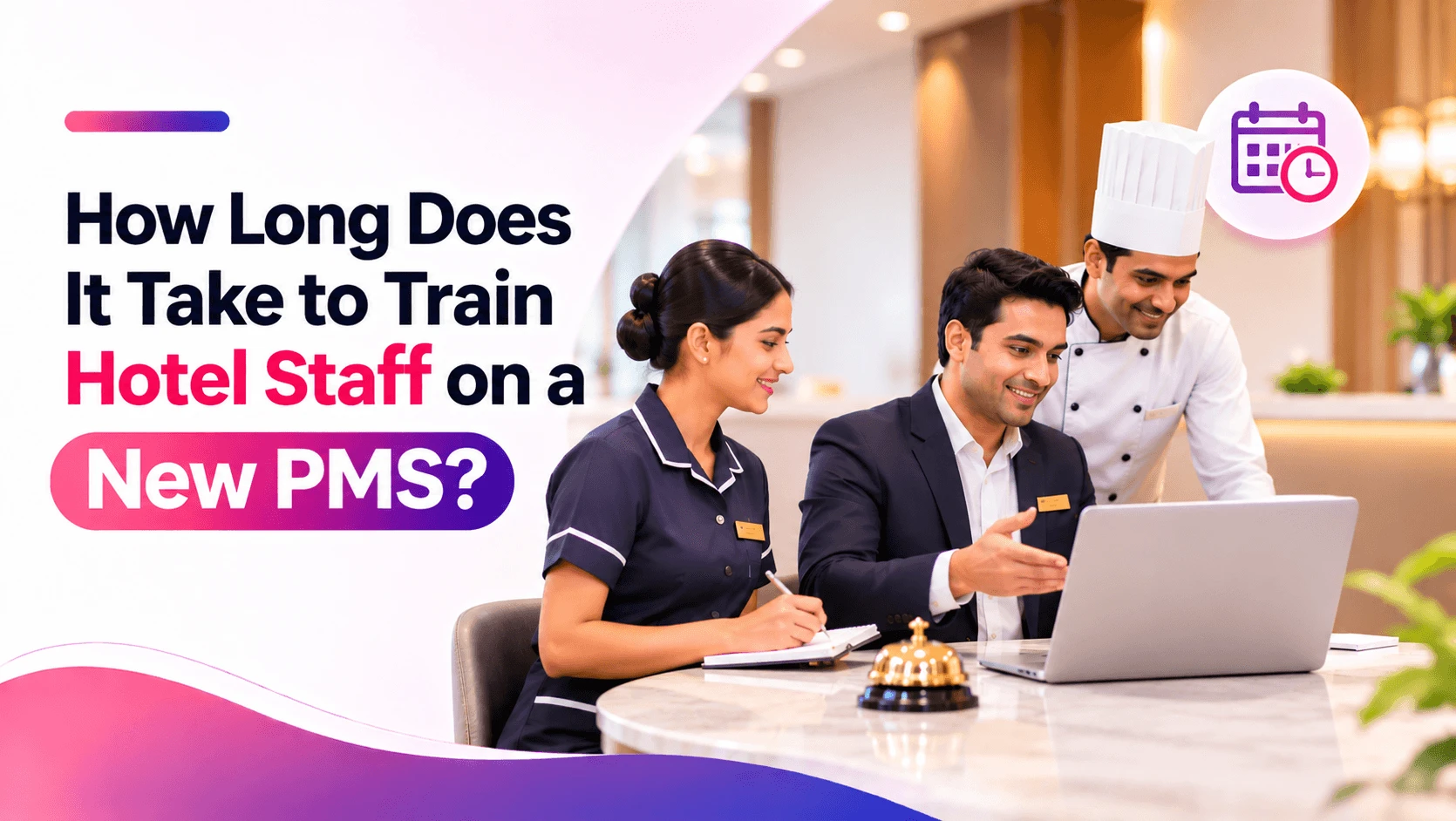
On an easy-to-use PMS, most hotel staff learn their daily tasks in a few hours to two days. They feel confident in about two to four weeks. On older, complex systems, it can take months: in a 2025 Cloudbeds survey, more than half of managers said front desk staff need four months to three years to feel confident. The software matters, but so does the training plan. Teaching each person only their own job, and letting them practise it with their own hands, is what makes training fast.
Neha is the general manager of a 40-room hotel. She has just signed up for a new PMS. Her front desk team is worried, and one senior receptionist has said, “The old system was fine. Why change it?”
Neha has two questions. How long before her team can use the new system without calling her every hour? And how does she get through the change without long queues at check-in?
This guide answers both. It gives realistic time ranges for each role, a simple plan for the first 30 days, and ways to get staff on board.
How Long Does PMS Training Take for Each Role?
Each role takes a different amount of time, because each person uses only part of the system. A housekeeper does not need the billing screen, and an accountant does not need the room assignment screen.
The table below shows typical ranges for a PMS that is easy to use. These are general ranges, not promises for any one product.
| Role | What they need to learn | Learn the daily tasks | Feel confident |
|---|---|---|---|
| Front desk | Bookings, check-in, check-out, room changes, bills | A few hours to 2 days | 2 to 4 weeks |
| Housekeeping | Room status, marking rooms clean or dirty | Under an hour | First few shifts |
| Restaurant and bar staff | Taking orders, KOTs, printing bills, charging to a room | A few hours | 1 to 2 weeks |
| Accounts | Day-end reports, payments, tax reports | 1 to 2 days | One full month-end close |
| General manager | Dashboard, reports, user access | A few hours | 2 to 4 weeks |
“Learn the daily tasks” means the person can do their normal job with someone nearby to help. “Feel confident” means they can handle a busy shift, fix their own small mistakes and help a new colleague.
Most of the time goes into the gap between those two. The first part happens in a training session. The second only comes from real shifts.
Industry surveys agree that an easy system cuts this time. In the HotelTechReport 2026 PMS Impact Study, which surveyed more than 1,200 hotels in 47 countries, 92% of hoteliers said modern PMS interfaces cut staff onboarding from weeks to days.
Why Does PMS Training Take Longer in Some Hotels?
When training drags on, the cause is usually one of these.
1. The software is hard to use. If a check-in takes ten clicks across four screens, staff need weeks just to remember the path. In the Cloudbeds PMS User Experience Report (January 2025), 52.2% of managers said front desk staff need between four months and three years to feel confident using their PMS. The survey covered 500 hotel employees at independent hotels and small chains in the US, UK, Canada, Mexico and Spain.
2. Everyone is taught everything. A two-hour session that walks through every menu leaves people tired and confused. They forget most of it by the next day.
3. Watching instead of doing. Staff who only watch a trainer click through screens do not remember the steps. They have to do the task themselves, more than once.
4. Training depends on one busy person. In the same Cloudbeds report, 73% of employees said they were trained by a supervisor or a colleague. When that person is also running the shift, training happens in bits and pieces.
5. High staff turnover. Every new hire needs training again. A hotel that loses many front desk staff each year is training almost all the time.
6. Too many systems at once. If the front desk has to learn a new PMS, a new POS and a new channel manager in the same week, everything takes longer.
A Simple PMS Training Plan for the First 30 Days
This plan covers training only. For moving data and the go-live day, see this guide on how to switch hotel PMS without losing bookings or guest data.
Before go-live: learn the daily tasks
- Make a list of the five to ten tasks each role does every day. Train only those first.
- Let each person do every task at least twice in the new system, on their own.
- Choose one “go-to” person per shift and train them a little deeper. They answer questions so the GM does not have to.
- Give each role a one-page sheet with their main steps.
Week 1: supervised real shifts
- Put the go-to person on every shift.
- Expect check-in to be slower for a few days. Plan an extra person for the busiest check-in hours if possible.
- At the end of each shift, write down every question staff asked. These show where training is still missing.
Week 2: practise the less common tasks
- Teach the tasks that come up less often, such as a room change, a split bill, an early check-out or a group booking.
- Run a short 15-minute session on the questions from week 1.
Weeks 3 and 4: build confidence
- Staff work without the go-to person standing next to them.
- Accounts goes through its first month-end in the new system.
- The GM checks the signs listed in the next section and closes any gaps.
After day 30: train new hires the same way
- Keep the one-page sheets up to date. A new hire uses the same sheets and the same “do it twice” rule.
If check-in queues are a worry during the change, these tips on reducing front desk wait times during peak check-in hours help in the first few weeks.
Why Does Hotel Staff Resist New Software?
Most staff are not against change. They are worried about looking slow or making mistakes in front of guests. A receptionist who has used the old system for five years is an expert in it. A new system turns them into a beginner overnight.
Here is how a GM can get staff on board:
- Explain the reason.: Tell staff what the old system made hard and how the new one helps them, not just the owner. For example: no more re-typing restaurant bills at night.
- Bring them in early.: Let one or two front desk staff join the vendor demo. People trust a system more when they helped choose it.
- Make the senior staff the experts.: Ask the most experienced receptionist to be a go-to person. Their knowledge of guests and hotel rules still matters.
- Allow mistakes in practice.: Use test bookings so staff can try things without fear.
- Notice progress.: Saying “check-in was faster today” in the shift briefing matters more than it sounds.
The right software matters for keeping staff too. In the Cloudbeds report, 38% of hotel employees said PMS usability influenced their decision to leave a job.
How Do You Know Your Staff Is Fully Trained?
A finished training session does not mean staff are trained. These signs are a better test:
- A check-in on a normal day takes about the same time as it did on the old system.
- Staff fix small mistakes themselves, such as a wrong room type, without calling anyone.
- The go-to person gets only a few questions a shift.
- The day-end reports match the cash and payments without long searching.
- A staff member can show a new colleague how to do a check-in.
If these are true for every role, training is done. Any that are not show exactly what to teach next.
What Should a Hotel Ask a PMS Vendor About Training?
Ask these questions in the demo, before signing:
- How long does it usually take a front desk person to learn check-in and check-out on your system?
- Is training included in the price, and is it online, on-site or both?
- Can our staff practise with test bookings before go-live?
- Is there a named person to call in the first weeks after go-live?
- Is there a way to train new hires later, such as videos or short guides?
- Can one of our receptionists try the system during the demo?
The last question is the most useful. A system that a receptionist can use in a short demo without help will be quick to train on. For more questions to ask before buying, see these 15 questions to ask before buying hotel PMS.
Conclusion
Training hotel staff on a new PMS takes a few hours to two days for the daily tasks and about two to four weeks to build confidence, if the system is easy to use and the plan is simple. Complex systems can take months. Teach each role only its own tasks, let people practise with their own hands, keep one go-to person per shift, and judge training by how the shifts run, not by how many sessions were held.
FAQs
How long does it take to train hotel staff on a new PMS?
Who needs the most PMS training in a hotel?
Should hotel staff be trained before or after go-live?
How can a hotel make PMS training faster?
What if staff refuse to use the new PMS?
Related Posts

Hospitality
How Can Hotels Handle Language Barriers With Foreign Guests?
12 Nov 2026
Hospitality
What Is FRRO Form C, and How Do Hotels Register Foreign Guests?
12 Nov 2026
Hospitality
Do Homestays Need a PMS? A Simple Guide for Guest Houses
11 Nov 2026